
Written by: The Editorial Team
Published: 4 Nov 2026
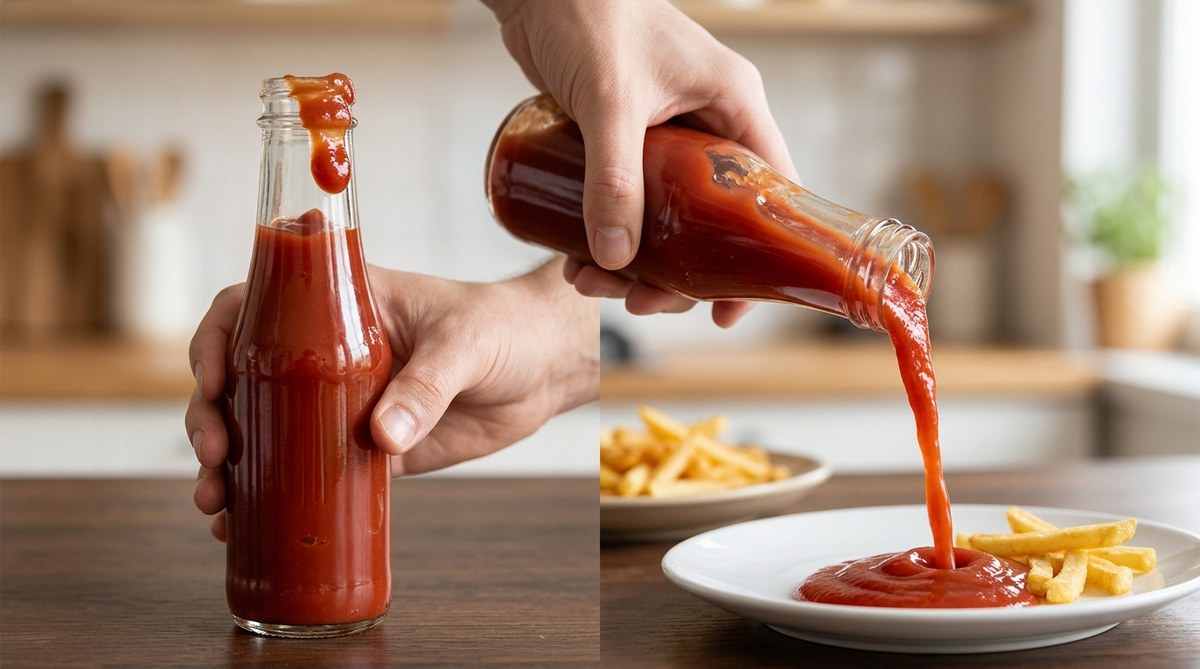
You flip the bottle. You tap the side. Nothing happens. Then, in a rush, a red blob splats onto your plate. This is the universal struggle of ketchup. It is a condiment that seems to have a mind of its own. One moment it holds its shape like a solid. The next, it flows freely like a liquid. It feels like a kitchen mystery, but the answer is rooted in physics.
Ketchup is a shear-thinning non-Newtonian fluid. Its viscosity drops dramatically when you apply force. At rest, the long molecules inside form a tangled structure that resists flow, acting like a solid. When you shake or squeeze the bottle, that structure breaks apart, and the ketchup suddenly pours like a liquid.
The Simple Science Behind the Split Personality
To understand ketchup, you first need to know how normal liquids behave. Water is a Newtonian fluid. Its thickness, or viscosity, stays the same no matter what you do. Pour it slow, and it flows slow. Pour it fast, and it flows fast. The liquid itself does not change.
Ketchup is different. It belongs to a class called non-Newtonian fluids. These materials change their viscosity based on the force applied to them. For ketchup, the force is called shear stress. Think of shear stress as the force that makes layers of fluid slide past each other. When you squeeze a bottle, you are applying shear stress. When you leave the bottle alone, you are not.
At rest, the tomato solids, sugar, and stabilizers in ketchup form a loose, jelly-like network. This network traps the liquid and holds everything in place. That is why a dollop of ketchup can sit on a plate for an hour and still look like a perfect mound. It behaves like a solid because the internal structure supports its own weight.
When you apply enough force, that network breaks. The bonds snap, and the trapped liquid is released. The ketchup suddenly becomes runny and pours easily. The harder you apply the force, the thinner it gets. This is why shaking the bottle vigorously works better than tapping it gently.
How to Get Ketchout of the Bottle Without the Mess
You do not need a degree in physics to win the battle with the bottle. You just need to understand the rules. Here is a practical, three-step process that uses the science to your advantage.
- Shake the bottle upside down. Turn the bottle over and give it a few firm shakes. This applies shear stress directly to the ketchup near the nozzle. It breaks the initial structure and gets the ketchup moving toward the opening.
- Tap the neck at a 45-degree angle. Do not hit the bottom. Tilt the bottle at a 45-degree angle and tap the side of the neck with your palm. This focuses the force right where the ketchup needs to exit. It prevents the sudden gush that happens when you hit the bottom.
- Pour steadily and stop early. Once you see the ketchup flowing, tilt the bottle back up before your plate is covered. The ketchup will keep moving for a second after you stop. This saves you from the dreaded blob that lands on your fries instead of your burger.
Common Mistakes That Make Ketchup Harder to Pour
Many people do the exact opposite of what the science says. They make the problem worse. The table below shows the most common mistakes and what you should do instead.
| Mistake | Why It Fails | The Better Approach |
|---|---|---|
| Hitting the bottom of the bottle | Force is absorbed by the entire column of ketchup. The bottom is far from the nozzle. | Tap the neck near the opening to localize the force. |
| Tapping while the bottle is upright | Gravity works against you. The ketchup has to flow up and out. | Turn the bottle upside down first so gravity helps. |
| Using a slow, gentle squeeze | Low shear stress does not break the internal structure. | Use a firm, sharp squeeze or a shake. |
| Storing the bottle on its side | The ketchup settles in the neck and dries out, forming a plug. | Store it upright so the nozzle stays clean. |
| Waiting for it to "warm up" on the counter | While temperature helps a little, it is not the main issue. The structure reforms as it cools. | Focus on applying force, not on temperature. |
Why Other Sauces Behave Differently
Ketchup is not the only non-Newtonian fluid in your fridge. Mayonnaise, yogurt, and even some salad dressings act similarly, but they do not behave exactly the same way. Mayonnaise is a shear-thinning fluid just like ketchup, but it is much thicker at rest. That is why it holds its shape on a sandwich better than ketchup does.
Yogurt, especially Greek yogurt, can also act like a solid until you stir it. The difference comes from the ingredients. Ketchup relies on pectin from tomatoes and added stabilizers like xanthan gum. These molecules create a fragile network that breaks easily under stress. Mayonnaise uses egg yolks and oil to create a stable emulsion that resists flow more strongly.
"The key to understanding ketchup is recognizing that its structure is temporary. The molecules are like a crowd of people standing still. They are locked in place. When you push through the crowd, people move out of the way, and the crowd flows. Let them stand still again, and they lock back into place."
What Happens Inside the Bottle at the Molecular Level
The long chain molecules in ketchup are called polymers. At rest, these polymers are tangled together like a bowl of spaghetti. They form weak bonds with each other, creating a network that spans the entire volume of the ketchup. This network gives the ketchup its solid-like resistance.
When you apply shear stress, the polymers begin to untangle. They align themselves in the direction of the flow. This alignment reduces the resistance and allows the liquid between the polymers to move. The more you stir, shake, or squeeze, the more the polymers align, and the thinner the ketchup becomes.
This is also why ketchup flows more easily after you have already poured some out. The first bit of ketchup that moves has already done the work of untangling the polymers near the nozzle. The rest follows with less resistance. That is why the first pour is always the hardest.
The Difference Between Ketchup and Cornstarch Slime
You may have seen videos of people running across a pool of cornstarch and water. That mixture is a different kind of non-Newtonian fluid. It is called a shear-thickening fluid. It gets thicker and more solid when you apply force. Ketchup is the opposite. It is a shear-thinning fluid.
The difference comes down to particle shape and interaction. Cornstarch particles are rigid and irregular. When you apply force, they jam together and lock into place, creating a solid. Ketchup particles are flexible and long. When you apply force, they slide past each other and untangle.
This is why you can poke a finger slowly into ketchup, but you cannot punch a pool of it. A slow poke applies low shear stress, and the ketchup stays solid. A fast punch applies high shear stress, and the ketchup becomes liquid, allowing your hand to pass through easily. The same principle applies to the bottle.
How Temperature Affects Ketchup Flow
Temperature plays a supporting role in the ketchup drama. Cold ketchup from the refrigerator is thicker than room temperature ketchup. The cold makes the tomato solids and stabilizers more rigid. The network of polymers is stiffer and harder to break. This is why ketchup straight from the fridge seems impossible to pour.
Warming the ketchup up reduces the viscosity of the liquid phase. The polymers become more flexible and easier to untangle. However, temperature alone is not enough. You still need to apply shear stress to break the network. A warm bottle that sits untouched will still resist flow. The best approach is to combine moderate warmth with a firm shake.
The Physics of the "Ketchup Thump"
The classic move of thumping the bottom of a glass ketchup bottle is a cultural tradition. It is also a physics lesson. The thump sends a shockwave through the glass and into the ketchup. This shockwave acts as a sudden, high-force shear event. It breaks the polymer network at the bottom of the bottle.
The problem is that this method is inefficient. The shockwave travels through the entire bottle, but the ketchup at the bottom is the last to exit. You end up breaking the structure far from the opening. The ketchup near the nozzle remains thick and stubborn. This is why the thump often leads to a delayed, explosive gush. The ketchup finally breaks free, and you get more than you bargained for.
Why Glass Bottles Are Worse Than Plastic
The material of the bottle matters. Glass bottles are rigid. You cannot squeeze them to apply shear stress. You have to rely on gravity and the thump method. Plastic bottles are flexible. You can squeeze them directly, applying focused shear stress right where it counts.
Plastic bottles also allow for a more gradual application of force. You can squeeze gently to start the flow and increase pressure as needed. With a glass bottle, you have one shot: the thump. If it works, you get ketchup. If it does not, you get frustration. This is why most ketchup brands have switched to squeeze bottles. The physics favors flexibility.
The Science of the Perfect Dollop
Once the ketchup is out of the bottle, it often resumes its solid-like behavior on the plate. A dollop of ketchup on a hot dog holds its shape because the polymer network reforms quickly. This is called thixotropy. The material becomes liquid under stress and returns to a gel-like state when the stress is removed.
This property is what makes ketchup such a useful condiment. It flows when you pour it, but it stays where you put it. It does not run off your burger or soak into your bun immediately. The temporary structure gives you control over where the ketchup goes. It is a design feature, not a bug.
Understanding Viscosity Helps in Other Areas
The principles that explain ketchup also apply to other materials. Paint is a shear-thinning fluid. It is thick in the can so it does not drip, but it flows smoothly when brushed onto a wall. Blood is also shear-thinning. It flows easily through narrow capillaries but thickens when it pools, helping to stop bleeding.
Learning why ketchup behaves like a solid and a liquid gives you a window into the world of materials science. It explains why some things are easy to pour and others are not. It also gives you a practical skill: you will never struggle with a ketchup bottle again.
The One Thing to Remember Next Time You Reach for the Bottle
The next time you are at a cookout or a diner, remember the secret. Ketchup is not being difficult. It is just following the rules of physics. It holds its shape because the molecules are tangled. It pours when you break that tangle with force. The solution is simple: apply firm, direct force near the opening, and the ketchup will cooperate.
So go ahead. Shake that bottle with confidence. You now know exactly what is happening inside. The solid becomes a liquid, and your fries get their topping.
Was this page helpful?
Our commitment to delivering trustworthy and engaging content is at the heart of what we do. Each fact on our site is contributed by real users like you, bringing a wealth of diverse insights and information. To ensure the highest standards of accuracy and reliability, our dedicated editors meticulously review each submission. This process guarantees that the facts we share are not only fascinating but also credible. Trust in our commitment to quality and authenticity as you explore and learn with us.