
Written by: The Editorial Team
Published: 28 Oct 2026
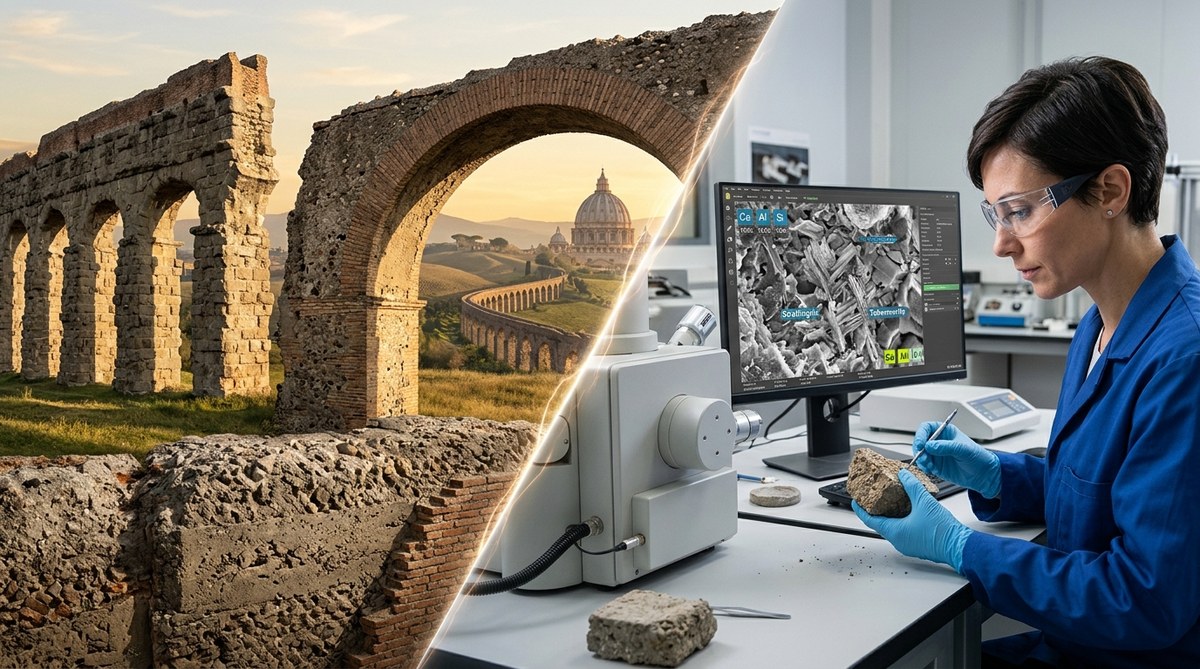
The Pantheon in Rome has stood for almost 1,900 years. Its unreinforced concrete dome is still the largest of its kind in the world. Meanwhile, modern concrete structures often show serious cracks within 50 years. That gap in longevity has frustrated engineers for decades. But in 2026, the mystery of Roman concrete durability has finally been solved.
Roman concrete lasted thousands of years because of a self-healing process triggered by lime clasts. When cracks formed, rainwater reacted with the dry lime to create a calcium-rich solution that filled the gaps. Modern concrete lacks these clasts, so cracks grow instead of healing. Engineers are now testing Roman inspired recipes to cut carbon emissions.
The Recipe That Changed History
Roman concrete, known as opus caementicium, was not a single formula. It evolved over centuries. But the core ingredients stayed consistent: volcanic ash (pozzolana), lime, seawater, and volcanic rocks called tuff. The Romans mixed these materials into a mortar that could set underwater.
That last property was a game changer. It allowed builders to construct harbors, breakwaters, and piers that held up against waves for two millennia. Modern Portland cement cannot set underwater without special additives. The Romans did it with simple chemistry.
The secret was the reaction between the volcanic ash and the lime. When seawater hit the mixture, it triggered a chemical reaction that formed a rare mineral called aluminum tobermorite. This mineral gave the concrete remarkable strength over time. But that was only half the puzzle.
The Missing Piece: Lime Clasts
For years, researchers noticed small white chunks in Roman concrete samples. They assumed these were poorly mixed ingredients or impurities. They were wrong.
Those white chunks were lime clasts. And they turned out to be the key to Roman concrete durability.
A team from MIT, Harvard, and several laboratories in Italy published a study that changed everything. They discovered that the Romans used a technique called "hot mixing." They added quicklime directly to the volcanic ash and aggregate, rather than slaking it with water first.
This created a dry, reactive mixture that produced those lime clasts. When the concrete eventually cracked, water seeped in. It dissolved the lime clasts, creating a calcium-rich solution. That solution recrystallized, filling the crack and sealing the structure.
This self-healing mechanism is why Roman concrete structures like the Pantheon and the Markets of Trajan still stand while modern concrete crumbles.
How Roman Concrete Durability Works in Practice
The self-healing process follows a simple cycle. Here is how it works:
- A crack forms in the concrete from stress, temperature change, or ground movement.
- Rainwater or groundwater enters the crack and reaches a lime clast.
- The water dissolves the calcium from the clast, creating a mobile solution.
- That solution flows into the crack and reacts with carbon dioxide in the air.
- Calcium carbonate crystals form, filling the gap and stopping the crack from growing.
This process can repeat indefinitely. As long as lime clasts remain in the concrete, the material can heal itself. The Romans did not know the chemistry, but they perfected the technique through trial and error.
What Modern Concrete Gets Wrong
Modern Portland cement is made by heating limestone and clay to extreme temperatures. This process releases massive amounts of carbon dioxide. In fact, cement production accounts for about 8 percent of global CO2 emissions.
But the problem is not just the carbon footprint. Modern concrete lacks the self-healing ability of Roman concrete. When a crack forms in a modern structure, it does not heal. Water enters, freezes, and expands. The crack grows. Steel reinforcement bars rust and expand, causing more cracking. Eventually, the structure needs expensive repairs or replacement.
Here is a comparison of the two approaches:
| Feature | Roman Concrete | Modern Concrete |
|---|---|---|
| Binder | Volcanic ash (pozzolana) + lime | Portland cement |
| Setting method | Hot mixing with quicklime | Wet mixing with slaked lime |
| Self-healing | Yes, via lime clasts | No |
| Crack behavior | Cracks seal over time | Cracks grow over time |
| Underwater use | Sets and hardens in seawater | Requires special additives |
| Carbon footprint | Lower (lower kiln temperatures) | Very high (8% of global CO2) |
| Longevity | 1,000+ years | 50 to 100 years |
The table makes the difference clear. Roman concrete was not just stronger in the long run. It was also more environmentally friendly.
Why It Took So Long to Crack This Mystery
Engineers have studied Roman concrete for centuries. But the lime clasts were always dismissed as a flaw. It took advanced imaging tools to understand their role.
Researchers used high resolution X ray microdiffraction and electron microscopy to analyze samples from ancient Roman structures. They found that the lime clasts were not accidental. They were deliberately produced by the hot mixing process.
The discovery was published in 2023, but 2026 has seen a surge in practical applications. Several companies are now testing Roman inspired concrete recipes that incorporate lime clasts for self-healing. Early results are promising.
The Three Key Lessons for Modern Engineers
If you are a civil engineer or a materials science student, here are the takeaways from this research:
- Hot mixing matters. Adding quicklime directly to the mixture creates the reactive clasts that enable self-healing. Modern methods that slake lime first remove this ability.
- Volcanic ash is not optional. The pozzolana from the Bay of Naples is chemically unique. It reacts with lime to form the minerals that give Roman concrete its strength. Replicating this with local materials requires careful formulation.
- Imperfections can be features. What looked like a mixing error turned out to be the most important part of the recipe. Engineers should question assumptions about what constitutes a defect.
"The Romans did not have the scientific tools we have today, but they understood material behavior through observation. They saw that their concrete lasted and kept using the same methods. We are only now catching up." Dr. Marie Jackson, geologist and Roman concrete expert.
Can We Use This Today?
The short answer is yes. Several research groups and startups are working on commercial versions of Roman inspired concrete.
One approach uses volcanic ash from the western United States to replicate the chemistry of pozzolana. Another method adds synthetic lime clasts to standard Portland cement mixtures. Both approaches show self-healing behavior in lab tests.
The biggest challenge is scale. The Roman Empire had access to specific volcanic deposits that are not available everywhere. But engineers are finding local alternatives. For example, fly ash from coal plants and certain types of clay can mimic some of the reactive properties.
The potential benefits are enormous. Self-healing concrete could reduce maintenance costs for bridges, roads, and buildings. It could also cut carbon emissions by extending the lifespan of concrete structures. If a Roman bridge lasted 2,000 years, a modern bridge designed to last 100 years is leaving a lot of performance on the table.
The Environmental Angle
Roman concrete durability has an environmental lesson that goes beyond chemistry. The Romans built to last. They did not plan for obsolescence. Their structures were designed for centuries, not decades.
Modern construction often prioritizes low initial cost over long term performance. This leads to more frequent repairs and replacements. Each replacement consumes energy and materials. The carbon footprint of a building includes its entire lifecycle, not just the day it was poured.
By learning from Roman methods, engineers can reduce the environmental impact of concrete. Lower kiln temperatures, self healing materials, and longer lifespans all contribute to a lower carbon footprint.
If you are interested in how other ancient innovations compare to modern technology, you might enjoy reading about how the moon became the basis for nearly every ancient calendar.
The Future of Self-Healing Concrete
Research into Roman concrete durability is accelerating. In 2026, the first commercial Roman inspired concrete mixes are being tested in real world projects. These include a pier in the Mediterranean and a bridge in the United States.
The results will determine whether this ancient technology can help solve a modern crisis. If the tests succeed, we could see a shift in how concrete is made and used. The material that built the Roman Empire might help build a more sustainable future.
The science is clear. The chemistry works. The only question is whether industry will adopt it.
What This Means for You
Whether you are a student, an engineer, or just someone curious about history, the story of Roman concrete is a reminder that old knowledge still has value. The Romans did not have electron microscopes. They did not know about calcium carbonate crystallization. But they observed, tested, and refined their methods over generations.
You can apply the same mindset to your own work. Look at the flaws. Question the assumptions. Sometimes the secret to a better solution is hiding in plain sight.
The next time you walk past a Roman ruin, take a moment to appreciate the engineering. Those walls were built by people who never saw a chemistry textbook. Yet they created a material that outlasts empires.
If this topic fascinates you, check out our collection of 30 facts about ancient civilizations for more insights into how old world knowledge still shapes our world.
Putting Roman Wisdom to Work
The research into Roman concrete durability is not just an academic curiosity. It has real world implications for how we build tomorrow.
Here is a list of practical steps that engineers and material scientists are taking right now:
- Testing local volcanic deposits as replacements for Italian pozzolana
- Adding synthetic lime clasts to standard Portland cement batches
- Developing hot mixing protocols that preserve the reactive clasts
- Monitoring pilot structures to measure self-healing over time
- Calculating lifecycle carbon savings from longer lasting concrete
Each of these steps moves us closer to concrete that can heal itself. The Roman method is not a perfect solution for every situation. But it offers a proven starting point.
The Pantheon has survived earthquakes, wars, and nearly two millennia of weather. Its concrete dome is still intact. That is not luck. That is engineering.
And now we finally know how they did it.
Was this page helpful?
Our commitment to delivering trustworthy and engaging content is at the heart of what we do. Each fact on our site is contributed by real users like you, bringing a wealth of diverse insights and information. To ensure the highest standards of accuracy and reliability, our dedicated editors meticulously review each submission. This process guarantees that the facts we share are not only fascinating but also credible. Trust in our commitment to quality and authenticity as you explore and learn with us.