
Written by: The Editorial Team
Published: 16 Sep 2026
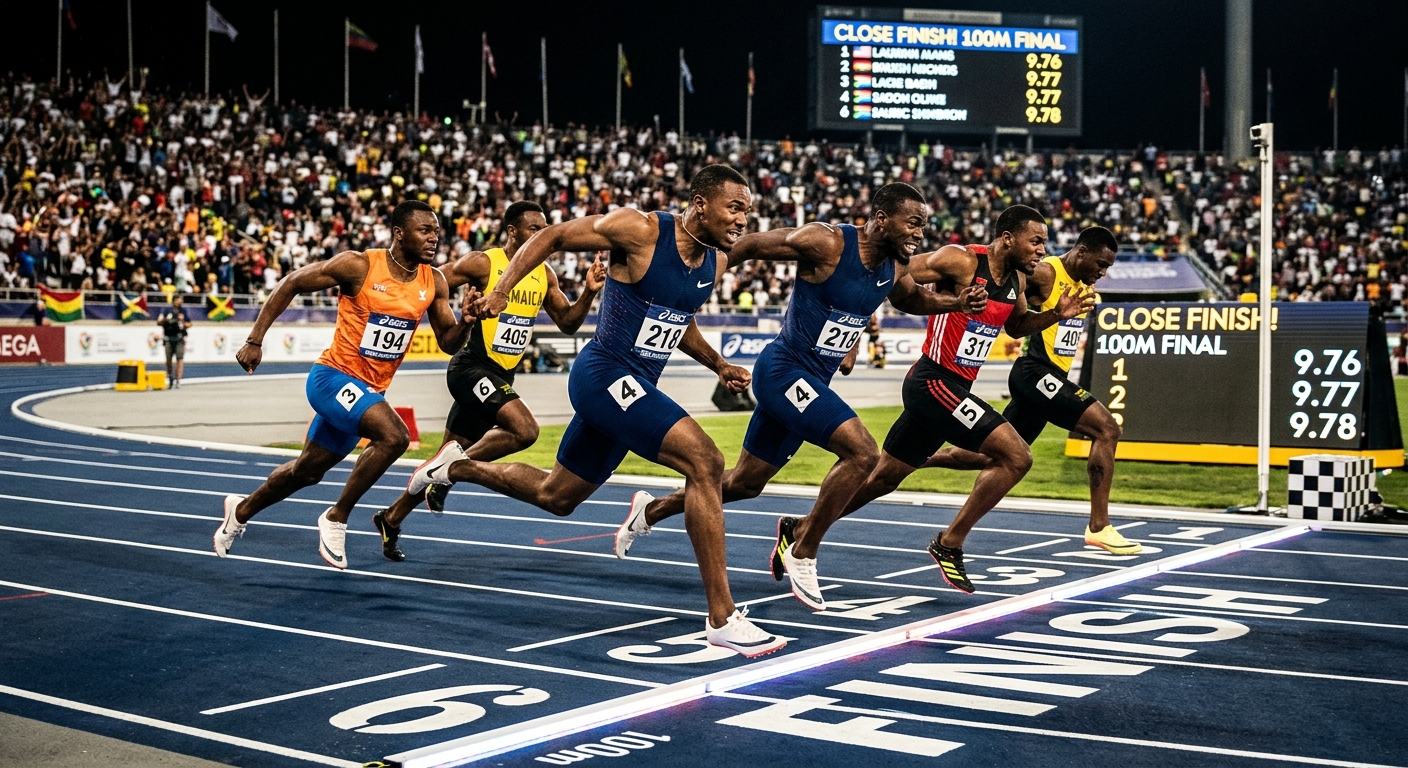
The fastest humans alive cover 100 meters in under 10 seconds. At that speed, the difference between a gold medal and fourth place can be smaller than the thickness of a fingernail. Sprint racing rewards precision in a way almost no other sport does, where biomechanics, lane geometry, timing technology, and international rules all converge in a few breathless seconds. These facts pull back the curtain on what really happens from the blocks to the finish line.
Race-Day Essentials
- Usain Bolt's 100m world record of 9.58 seconds has stood since the 2009 World Championships in Berlin.
- World Athletics mandates fully automatic timing accurate to 1/1000th of a second before any sprint world record can be ratified.
- A legal start requires a reaction time of at least 0.100 seconds after the gun fires, based on biomechanical research into the human nervous system.
World Record Margins Across the Sprint Distances
The four main sprint distances raced at the Olympics are the 100m, 200m, and 400m. Each world record tells its own story about the ceiling of human speed.
Bolt's 9.58-second 100m mark is 0.11 seconds faster than the second-best performance ever recorded. At his peak velocity during that Berlin final, he was traveling at approximately 12.4 meters per second, close to 44.7 km/h. The gap between first and last in that race was roughly half a second, yet every finisher was among the fastest humans to ever live.
The 200m world record also belongs to Bolt, at 19.19 seconds from that same 2009 championships. Running from lane 5, he executed near-perfect bend mechanics before unleashing on the straight. The curved first half of the 200m generates momentum through the bend, which elite runners convert into maximum speed on the home straight.
Wayde van Niekerk owns the 400m world record at 43.03 seconds, set at the 2016 Rio Olympics from lane 8. He ran the entire race without seeing a single competitor, pacing himself entirely by feel and split targets. He broke Michael Johnson's 17-year-old record by nearly a third of a second, a margin that shocked even seasoned analysts.
The Physics Behind Explosive Acceleration
A sprint race is not one continuous effort. It is a sequence of overlapping phases, each governed by different physical demands.
The drive phase covers roughly the first 30 meters of a 100m race. During this phase, a sprinter's body angle sits at approximately 45 degrees or less relative to the track surface. The priority is horizontal force production. Every foot strike pushes backward and downward, generating a reaction force that drives the athlete forward.
Peak velocity in elite 100m races arrives between 60 and 80 meters. After that point, even the fastest sprinters experience a small drop in speed. What looks like acceleration over the final 20 meters is often a runner decelerating more slowly than their rivals, which is itself a trained and measurable skill.
Step frequency and stride length both peak at different moments in the race. Frequency rises quickly and levels off early. Stride length continues growing into the mid-race phase. The precise interaction between these two variables determines who reaches maximum speed first and who can sustain it through the finish.
The 400m introduces a distinct physiological challenge: lactic acid accumulates in muscle tissue during the final 100 meters, producing the visible deceleration that characterizes even world-class finishes. Managing that metabolic load is one of the primary physiological divides between 400m specialists and pure sprinters.
Lane Assignment Rules and the Geometry of the Track
Lane assignment in major sprint finals is not drawn at random. World Athletics protocols govern the process to balance competitive fairness against the geometric realities of a 400-meter oval track.
For 100m finals, lanes are assigned based on semi-final performance. The fastest qualifiers receive the central lanes, typically lanes 4 and 5, because those positions provide the clearest peripheral view of nearby competitors. Lanes 1 and 8 are generally considered less favorable, with reduced visual feedback from the field.
The 200m and 400m introduce staggered starting positions. Because outer lanes follow a longer arc, starting marks are offset forward so every runner covers the same total distance. In a standard 400m race, the lane 8 starting block can sit more than 40 meters ahead of the lane 1 mark by the time the stagger is fully applied, even though the total race distance is identical.
Van Niekerk's record-breaking run in lane 8 at Rio is widely cited as one of the most striking examples of self-paced execution in sprint history. Running completely blind to his rivals throughout the race, he posted a first-200m split of approximately 21.4 seconds and held his form through the finish. The outer lane stagger transformed what could have been a psychological disadvantage into a controlled, time-trial style performance.
Timing Technology and the Thousandths That Decide Races
Fully automatic timing, universally known as FAT, fires the clock at the precise instant the starter's pistol discharges. The signal travels directly from the gun to the timing system, removing human reaction delay from the equation entirely. No official international sprint result has been determined by a manually operated stopwatch for decades.
At the finish line, a high-speed camera continuously scans a thin vertical slit of the track, building an image column by column over time. The resulting strip shows the precise finish order and timing of every athlete to 1/1000th of a second. For athletes separated by margins the human eye could not process in real time, this image is the definitive record of the result. Anyone curious about how those strip images are read, when results become dead heats, and what rules govern tied finishes can find a thorough breakdown in this guide to photo finish facts.
World Athletics also requires that wind gauge readings be recorded for 100m, 200m, and 110m hurdles performances. A legal tailwind limit of 2.0 meters per second applies for record purposes. The anemometer is positioned at the 50-meter mark for 100m races and reads for the full duration of the race. Any performance recorded with a wind reading above the legal limit is valid for placement purposes but cannot stand as a world record.
False Start Rules and the Reaction Time Threshold
The 0.100-second reaction time rule is one of the more scrutinized regulations in track athletics. It rests on biomechanical research showing that the human nervous system cannot consciously process an auditory stimulus and deliver a motor response to the legs in under 100 milliseconds. Any recorded block reaction time below that threshold is automatically classified as a false start, regardless of whether the movement appeared intentional to observers.
In 2010, World Athletics changed the false start rule to allow only one false start per race rather than one per athlete. A single false start by any competitor in the field now results in immediate disqualification of that athlete. This shift placed significantly greater pressure on all runners from the moment they took their marks.
Starting block sensors measure the force each athlete exerts throughout the set position and in the milliseconds after the gun fires. The system logs the precise instant when force begins to change, giving officials objective data to evaluate any suspected early movement. Protests against false start calls must engage directly with this sensor record.
What Governing Bodies Check Before Ratifying a World Record
Posting a fast time on the track is not the same as entering the world record books. World Athletics publishes a detailed set of conditions that must all be satisfied simultaneously before a performance is ratified.
- Fully automatic timing with a certificate from an approved timing provider
- Wind reading at or below +2.0 m/s, recorded by a calibrated anemometer at the 50-meter mark
- Doping control samples collected immediately after the race and later tested under anti-doping protocols
- Track and equipment certification confirming the surface meets World Athletics facility standards
- Photo finish records retained as part of the official documentation package
- An official race report submitted by the technical delegate present at the competition
The 400m has no wind measurement requirement because the race covers a full lap, making a single wind reading unrepresentative. All other technical criteria still apply in full. Performances set at altitudes above 1,000 meters are valid but noted separately in certain record categories, since thinner air reduces aerodynamic drag and can assist sprint times.
The World Athletics records show that the 100m world record has been broken fewer than ten times since fully automatic timing became standard in the late 1970s. That figure reflects how rarely the necessary combination of peak human performance, legal wind, certified conditions, and clean anti-doping clearance all align on the same day.
The 400m as a Physiological Category of Its Own
The 400m occupies territory between pure speed and middle-distance endurance that no other Olympic sprint event covers. It is too long to run at maximum sprint pace from start to finish, but too short to distribute effort conservatively from the gun.
Elite 400m runners typically complete the first 200m in approximately 21 to 22 seconds and the second 200m in 22 to 24 seconds. Minimizing that split between the two halves is the central tactical aim. A large positive split, meaning a significantly slower second half, indicates that the athlete went out beyond their sustainable pace in the opening lap.
Training for the event develops three distinct energy systems simultaneously: the phosphocreatine system for explosive starts, the glycolytic system for sustained high-speed running, and the aerobic system for between-session recovery and late-race management. Few other track events demand proportional development across all three in the way a competitive 400m does.
Track Geometry Details That Affect Every Sprint
A few structural facts about standard athletics tracks that shape sprint outcomes at every level of competition:
- Lane width on a World Athletics-certified track is 1.22 meters, with the lane line itself included in each lane's measurement
- The tighter radius in lane 1 places slightly different centripetal force demands on a runner's outside leg compared with the more gradual curve of outer lanes
- The 200m start line in lane 1 sits at the top of the final bend, while the lane 8 start line can sit past the midpoint of the back straight due to accumulated stagger
- A certified 400m track surface must conform to World Athletics Facility Manual specifications covering shock absorption, vertical deformation, and friction coefficients
The Question of Human Limits in Short Sprints
Physiologists and biomechanists have been debating whether Bolt's 9.58 seconds represents a species ceiling or simply the current generation's plateau. Biomechanical models estimating theoretical minimums point to somewhere around 9.4 to 9.5 seconds based on ground contact time, stride mechanics, and muscle fiber contraction rates, but those models carry wide uncertainty ranges.
Sprint performance improved substantially after synthetic track surfaces replaced cinder tracks in the late 1960s. Rubberized polyurethane reduced energy loss at ground contact and contributed to a wave of record improvements in the years that followed the transition.
Modern sprint spikes have also evolved considerably. Current elite designs embed carbon fiber plates in a minimalist sole, bringing some models under 100 grams while stiffening the forefoot to improve energy return. The governing bodies have scrutinized footwear technology more closely in recent years, following rule changes limiting sole thickness in field events, suggesting that sprint footwear may face tighter specification in future competition cycles.
How Finish-Line Rules Determine the Official Result
The moment a runner's torso crosses the finish line determines the official result. Not the head, not the outstretched arms, but the chest. This rule surprises many first-time viewers. It explains why experienced sprinters lean aggressively at the tape rather than raising their arms before crossing it. A premature celebration gesture can cost a medal when the margin is hundredths of a second.
When two athletes finish within 0.001 seconds of each other and the photo finish image cannot resolve a clear order, the result is recorded as a dead heat. The procedures for advancing athletes in multi-round competitions when a dead heat occurs vary by meet regulations but are specified before competition begins by the organizing body, not decided on the day.
Athletes cannot access official timing data before results are announced. Formal protests against timing results require supporting evidence and go through a structured challenge process. In practice, FAT results are almost never overturned, because the camera strip and sensor logs form an objective record that is independent of any human judgment made at the moment of the finish.
The Numbers Behind the Legend of That Berlin Final
The 2009 World Championships 100m final remains one of the most analyzed sprint races in the history of the event. Six of the eight finalists ran personal best times. The conditions, a fast track, a near-calm wind reading, and a field of the deepest collective talent ever assembled for a 100m final, produced a data set that biomechanists still reference when modeling elite sprint performance.
Bolt's record has now stood for more than 15 years. That is the longest an unbroken 100m world record has persisted since the era of hand timing, a comparison that underscores either the exceptional nature of his performance or the structural difficulty facing the current generation of sprinters in pushing beyond that number, or both.
Where Sprint Facts and Track Science Meet
Sprint racing at the elite level compresses physics, biology, and regulation into a few seconds of motion. The margins between competitors are genuine. A hundredth of a second separating medalists is not an artifact of rounding in the results system. It reflects differences in ground contact time measured in milliseconds, reaction speeds that land just inside or outside a legal threshold, and force outputs that biomechanists require slow-motion analysis to fully interpret.
The governing rules exist precisely because the margins are so narrow. Timing standards, wind measurement protocols, lane assignment procedures, and photo finish technology are not bureaucratic formalities. They are the infrastructure that makes it possible to state, with confidence, who ran faster on that day, under those conditions, by that specific margin. Every sprint world record currently in the books passed through that infrastructure before anyone wrote it down as official.
That combination of peak human performance and meticulous measurement is what makes sprint racing one of the most data-rich and scientifically rigorous events across all of athletics.
Was this page helpful?
Our commitment to delivering trustworthy and engaging content is at the heart of what we do. Each fact on our site is contributed by real users like you, bringing a wealth of diverse insights and information. To ensure the highest standards of accuracy and reliability, our dedicated editors meticulously review each submission. This process guarantees that the facts we share are not only fascinating but also credible. Trust in our commitment to quality and authenticity as you explore and learn with us.