
Written by: The Editorial Team
Published: 21 Oct 2026
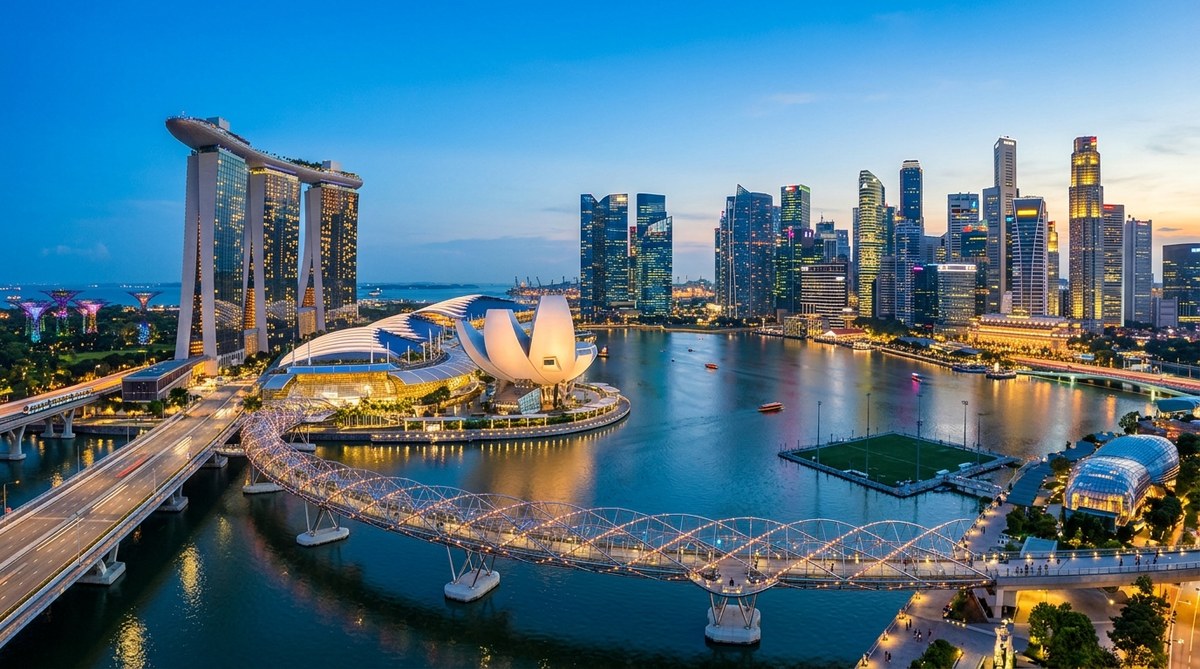
You step off the plane at Changi Airport and the future hits you. Not in a loud, flashy way. It hits you in the quiet hum of automated systems, the living walls of tropical greenery, and the sheer precision of the skyline ahead. Singapore does not just look futuristic. It feels like a city that was designed by people who actually thought about how we want to live fifty years from now. And in 2026, that feeling is stronger than ever.
Singapore earns the title of most futuristic city in the world 2026 by blending vertical gardens, smart infrastructure, and sustainable architecture into one seamless skyline. The city does not just build tall. It builds with purpose. Every tower, park, and transit line supports a vision that balances density with livability. For architecture lovers and forward-thinking travelers, Singapore is the blueprint for urban life in the decades ahead.
The Skyline That Refuses to Look Back
Most cities grow organically over centuries. Singapore had a different plan. After independence, the government made a deliberate choice to build upward and outward with intention. The result is a skyline that feels less like a collection of buildings and more like a curated exhibition of what architecture can achieve.
Take Marina Bay Sands. That hotel with the ship on top? It is not just a photo op. The SkyPark connects three towers with a cantilevered deck that seems to defy gravity. It was completed over a decade ago, but it still looks like it belongs on a concept board for a colony on Mars. And the towers themselves are clad in glass that reflects the water and the Supertrees, making the whole bay feel like a single, unified ecosystem.
Then there is the CapitaSpring tower. This building is a living example of biophilic design. A vertical garden climbs up its facade, and inside, a four-story "green oasis" called the Green Oasis sits right in the middle of the office floors. Workers take meetings surrounded by ferns and cascading plants. It is not a gimmick. It is a statement that the future of office design must include nature, not block it out.
How the Supertrees Rewrote the Rules
The Gardens by the Bay Supertrees are probably the most photographed structures in Singapore. But they are more than just giant metal trees. Each one is a vertical garden that collects rainwater, generates solar power, and acts as an exhaust for the cooled conservatories below.
Think of them as the city's lungs. They cool the surrounding air, support biodiversity, and at night, they put on a light and sound show that draws crowds from around the world. The Supertrees are not decoration. They are a working piece of infrastructure that proves a skyline can be both iconic and functional.
Here is what makes them so special:
- They are covered in over 150,000 plants from around the globe.
- Some Supertrees are connected by a suspended walkway 22 meters up.
- The entire grove is designed to mimic the role of real trees in a forest.
If you want to see what happens when engineers and botanists work together, this is it.
A Blueprint for Sustainable Urban Density
Singapore is small. It is a city-state with limited land and resources. That constraint forced the country to become a master of density. But unlike many dense cities that feel cramped, Singapore uses design to create breathing room.
The public housing blocks, which house over 80 percent of residents, are often built around communal gardens, rooftop farms, and sky bridges. The government mandates that new developments include green spaces. The result is a skyline that does not just rise. It breathes.
The Punggol Digital District is a perfect example. It is a new kind of business park where offices, schools, and homes share the same block. The buildings are connected by elevated walkways through a forested park. There are no cars on the ground level. Everything is walkable. It is a small city within a city, designed for a future where remote work and local living blend together.
The Role of Smart Technology in the Skyline
A futuristic skyline is not just about how buildings look. It is about how they operate. Singapore is one of the most sensor-dense cities on the planet. Thousands of sensors monitor everything from air quality to foot traffic to energy use in real time.
The Marina Bay area uses a district cooling system. Instead of each building running its own air conditioning, chilled water is piped from a central plant. This cuts energy use by about 30 percent. The buildings themselves are designed to maximize natural light and reduce heat gain.
And then there is the autonomous vehicle network. In the new Tengah district, driverless shuttles move residents around a car-free town center. The buildings are designed with integrated drop-off points for these shuttles. It is not a pilot program. It is the standard for new developments.
Singapore also uses digital twins for its infrastructure. A digital twin is a virtual copy of a building or a bridge that updates in real time. Engineers can test stress points, predict maintenance needs, and even simulate disasters without touching the real structure. This is the kind of invisible technology that makes a skyline truly smart.
What Other Cities Can Learn
| Aspect | Singapore Approach | Common Mistake Elsewhere |
|---|---|---|
| Greenery | Integrated into every building | Added as an afterthought on rooftops |
| Density | High but with communal green space | High but with narrow streets and noise |
| Technology | Centralized sensors and digital twins | Silos between different systems |
| Transport | Car-free zones with autonomous shuttles | Traffic-heavy urban cores |
| Housing | Mixed-income with shared gardens | Segregated by income with little shared space |
Singapore proves that density does not have to mean sacrifice. It can mean better design.
Why Architecture Enthusiasts Can Not Miss This Skyline
For anyone who loves architecture, Singapore is a living textbook. You can see the influence of modernist pioneers like Le Corbusier in the early HDB blocks. Then you see the shift toward parametric design in the ArtScience Museum, which looks like a lotus flower opening its petals. The Helix Bridge is a double-helix structure that references DNA. The National Gallery Singapore repurposed the old Supreme Court and City Hall into a museum, keeping the colonial facades while adding a modern glass roof.
The city does not tear down its past to build the future. It incorporates old and new into a single, layered skyline.
- Start your tour at Marina Bay and walk the Helix Bridge at sunset.
- Visit the SkyPark at Marina Bay Sands for the full view.
- Spend an afternoon at Gardens by the Bay, both the cooled conservatories and the Supertree Grove.
- Take the MRT to Punggol and walk through the Digital District.
- End your day with dinner at a rooftop farm in one of the public housing blocks.
That last one is important. The future of Singapore is not just in the tourist spots. It is in the everyday spaces where people live, work, and grow food on their own rooftops.
The Edge of Tomorrow
Singapore is not resting. In 2026, the city is already working on its next phase. The Long Island project will reclaim land to protect against rising sea levels, and that new land will include parks, housing, and a new waterfront skyline. The Jurong Lake District is being built as a second central business district, complete with smart grids and green corridors.
"Singapore has always treated urban planning as a system, not a collection of projects. That is why its skyline feels so cohesive."
— Khoo Peng Swee, urban design professor at the National University of Singapore
The city is also experimenting with underground infrastructure. A whole network of tunnels for utilities, transport, and even storage is being built beneath the existing city. This frees up surface space for people and parks. It is the kind of forward thinking that most cities only dream about.
Your Next Trip Should Include This Skyline
If you are a traveler who loves cities that feel alive and evolving, Singapore is the place to be in 2026. The skyline is not a static postcard. It is a living project that changes every year. New towers rise. Old buildings get green roofs. Parks extend upward onto bridges and balconies.
You can see the ambition in every corner. From the way the Supertrees glow at night to the way a bus stop has a living wall of ferns, the message is clear. This city is not done building its future. And you can watch it happen in real time.
So book that flight. Walk the Helix Bridge. Stand under a Supertree. And let yourself feel what a city looks like when it decides to build for the next century, not just the next quarter.
Was this page helpful?
Our commitment to delivering trustworthy and engaging content is at the heart of what we do. Each fact on our site is contributed by real users like you, bringing a wealth of diverse insights and information. To ensure the highest standards of accuracy and reliability, our dedicated editors meticulously review each submission. This process guarantees that the facts we share are not only fascinating but also credible. Trust in our commitment to quality and authenticity as you explore and learn with us.