
Written by: The Editorial Team
Published: 23 Oct 2026
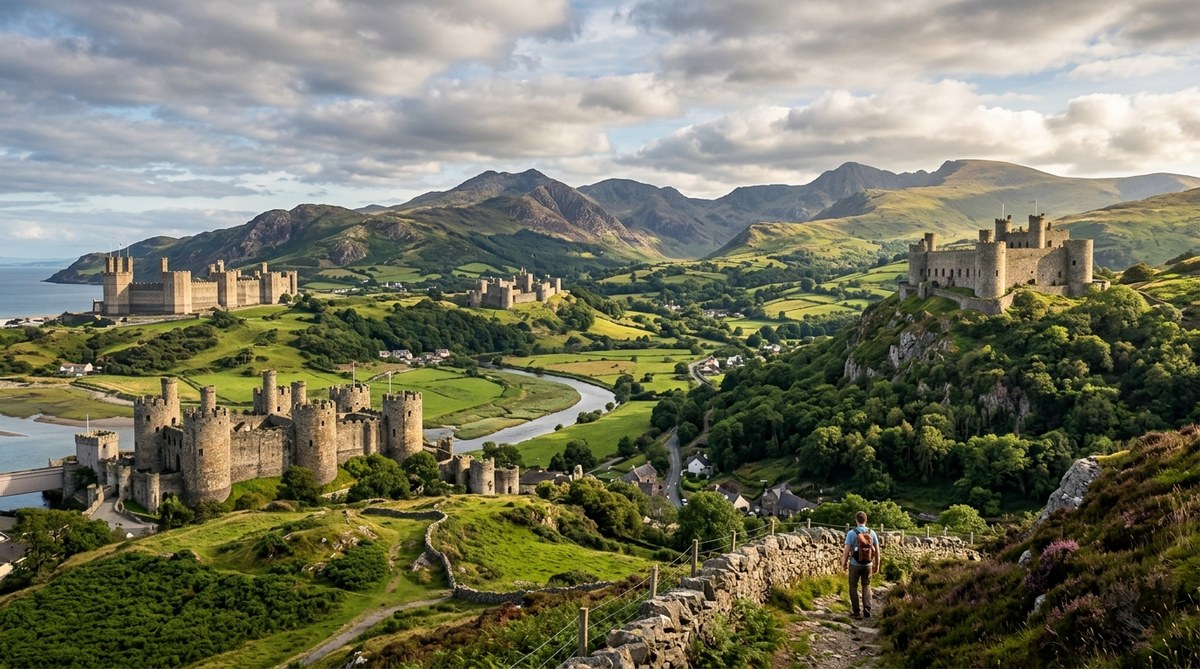
Wales is a small country. You could fit it inside the state of Oregon nearly three times. Yet this compact nation of green valleys and gray mountains holds more castles per square mile than any other place in Europe. The numbers are staggering. Historians count over 600 castle sites scattered across Wales, with roughly 100 still standing in good condition. For comparison, the entire United States has fewer than 2,000 castles total. Why did so many fortresses end up in one small corner of the British Isles?
Wales has so many castles because it was the battleground of a long, violent struggle between native Welsh princes and English kings. Both sides built fortresses to control territory, suppress rebellion, and project power. The rugged landscape forced builders to construct many small strongholds rather than a few large ones, creating the highest castle density in Europe.
The Two Sides of a Castle War
The story of Welsh castles is not a simple one. It involves two very different groups of builders with opposite goals.
The first group were the native Welsh princes. Before the English arrived in force, Welsh rulers built defensive structures called "llysoedd" (wooden hillforts) and later stone castles. These were usually small, practical fortresses designed to protect local communities and control strategic river crossings. The princes of Gwynedd, Powys, and Deheubarth each maintained their own networks of strongholds.
The second group were the English kings, especially Edward I. After Edward conquered Wales in the late 13th century, he launched the most expensive castle-building program in medieval European history. His "Iron Ring" of castles at Conwy, Caernarfon, Beaumaris, and Harlech was designed to surround and dominate the Welsh population.
This clash between two castle-building cultures created the density we see today.
Why the Geography of Wales Matters
Wales is a land of mountains, valleys, and a long coastline. Before modern roads, travel through the interior was slow and dangerous. Armies could not move easily through the narrow passes.
Castle builders took advantage of this terrain. They placed fortresses on hilltops, at river mouths, and along the few usable roads. Each valley needed its own castle to control movement. A single large castle could not dominate the whole region the way it might on open plains.
Think of it like a series of locks on a canal. Each valley was a separate compartment that needed its own guard post. The result was a patchwork of castles, each watching over its own stretch of land.
The Norman Influence
The Normans invaded England in 1066, but they did not stop there. By the 1070s, Norman lords were pushing into the Welsh Marches, the borderlands between England and Wales.
These early Norman castles were made of earth and timber. Builders raised a mound called a "motte" and topped it with a wooden tower. A fenced courtyard called a "bailey" sat at the base. These motte-and-bailey castles were cheap and could be built in weeks.
The Normans used a strategy of "castle and borough." They built a castle, then planted a town beside it with English settlers. The town provided supplies and soldiers. The castle protected the town. This pattern repeated dozens of times along the border.
Many modern Welsh towns started this way. If you visit a town in Wales with a castle at its center, there is a good chance it began as a Norman settlement.
Edward I and the Iron Ring
The most famous chapter in Welsh castle history began in 1277. King Edward I of England decided to crush Welsh resistance once and for all. He brought an army, a fleet of ships, and a master architect named James of St. George.
Edward built a ring of massive stone castles along the coast of North Wales. These were not simple defensive structures. They were statements of power. The walls were thick. The towers were tall. The gatehouses were designed as kill zones where attackers would be trapped.
Here is a numbered list of the steps Edward used to build his castle network:
- Choose a coastal or riverside site where supplies could arrive by ship.
- Clear the land and dig the foundation trenches.
- Build the outer walls first, using local stone when possible.
- Construct the inner buildings: great hall, kitchens, barracks, and chapel.
- Add the finishing touches: battlements, arrow slits, and decorative stonework.
- Garrison the castle with English soldiers and supply it from the sea.
This method worked. The castles of Edward I never fell to a Welsh attack. They remain some of the best preserved medieval fortifications in the world.
Welsh Castles Built by the Welsh
Not all Welsh castles were built by English kings. The Welsh built their own, and some of them are impressive.
The princes of Gwynedd, especially Llywelyn the Great and his grandson Llywelyn ap Gruffydd, constructed stone castles at sites like Dolwyddelan, Castell y Bere, and Ewloe. These castles were smaller than Edward's giants, but they were cleverly designed. Welsh builders used the landscape masterfully, tucking castles into rocky outcrops and hidden valleys.
Welsh castles often had a single tower keep rather than a massive concentric design. They were built for observation and defense, not for housing a large garrison. A Welsh prince might have a dozen small castles rather than one enormous one.
This difference in approach added to the total count. The English built big. The Welsh built many.
The Wars That Kept Builders Busy
Wales saw nearly continuous conflict from the Norman invasion until the early 1400s. Every generation brought a new war, and every war brought new castles.
The Welsh revolts of 1282, 1294, and 1316 each prompted castle repairs and new construction. The revolt of Owain Glyndr in the early 1400s led to the last round of major castle building in Wales. Even after the military need faded, landowners continued to build fortified manor houses that looked like castles.
Here is a bulleted list of the major conflicts that drove castle construction:
- Norman invasion of South Wales (1070s-1120s)
- The campaigns of King John (early 1200s)
- The conquest of Llywelyn ap Gruffydd (1277-1283)
- The revolt of Madog ap Llywelyn (1294-1295)
- The rebellion of Owain Glyndr (1400-1415)
- The Wars of the Roses (1455-1487)
Each of these conflicts left new castles or major renovations behind.
What Makes a Castle a Castle?
People sometimes argue about what counts as a castle. Does a fortified manor house qualify? What about a tower house?
For the purposes of counting, most historians use a broad definition. A castle is a fortified residence of a lord or noble. It must have defensive features like walls, towers, or battlements. It must also have been a home, not just a military outpost.
This definition includes everything from the massive stone fortresses of Edward I to the small tower houses of the Welsh gentry. It excludes purely military forts built later, like the Napoleonic era forts along the coast.
The table below shows the different types of castles in Wales and their characteristics.
| Castle Type | Builders | Typical Features | Number of Examples |
|---|---|---|---|
| Motte-and-bailey | Normans | Earth mound, wooden tower, fenced courtyard | Over 100 sites |
| Stone keep | Welsh princes | Single square tower, thick walls | About 50 |
| Concentric | Edward I | Multiple rings of walls, massive gatehouses | 8 major examples |
| Tower house | Welsh gentry | Tall narrow tower, small footprint | Over 200 |
| Fortified manor | English lords | House with defensive walls, gatehouse | About 75 |
"Wales has the highest concentration of castles in Europe because it was the most fought over piece of land in the medieval period. Every valley, every river crossing, every hilltop needed a castle." - Dr. Marc Morris, medieval historian
The Economics of Castle Building
Building a castle was expensive. Edward I spent over 80,000 pounds on his Welsh castles, an astronomical sum for the time. To put that in perspective, a skilled worker earned about 2 pence per day. A single large castle could cost the equivalent of millions of dollars today.
Why spend so much? Because castles worked. They controlled territory, protected tax collectors, and provided bases for military campaigns. A well placed castle could dominate a region for centuries.
The cost also explains why there are so many smaller castles. Not every lord could afford a Caernarfon. But many could afford a small tower house or a fortified manor. These smaller structures multiplied across the landscape.
The Afterlife of Welsh Castles
After the union of England and Wales in the 16th century, the military need for castles faded. Many fell into ruin. Some were stripped of their stone for building materials. Others became romantic ruins in the 18th and 19th centuries.
The Romantic movement changed how people saw castles. Artists painted them. Poets wrote about them. Tourists began to visit them. By the Victorian era, castle tourism was already established.
Today, the Welsh government agency Cadw manages many of the best castles. They are open to the public and draw millions of visitors each year. The castles have become a major part of Welsh identity and a powerful draw for travelers.
Planning Your Castle Visit in 2026
If you want to see Welsh castles for yourself, you have many options. Here are the ones that should be on your list.
- Caernarfon Castle is the most famous. Its polygonal towers and banded stonework make it instantly recognizable. Edward I built it to be his administrative center in North Wales.
- Conwy Castle is a masterpiece of medieval military architecture. You can walk the entire wall walk and look out over the town and harbor.
- Beaumaris Castle on Anglesey is unfinished but brilliant. Its concentric design is the most sophisticated in Britain.
- Harlech Castle is the smallest of Edward's major castles, but it sits on a dramatic cliff overlooking the sea.
- Caerphilly Castle in South Wales is the second largest castle in Britain. It has a famous leaning tower and a massive gatehouse.
- Cardiff Castle is unusual because it was rebuilt in the 19th century as a Gothic fantasy. It sits right in the city center.
For a deeper look at these sites, check out our collection of facts about castles in Wales.
The Legacy of Conflict
Wales has so many castles because it was a battlefield for centuries. The Normans came first, building their motte-and-bailey strongholds. The Welsh princes followed, constructing stone keeps in the mountains. Then Edward I arrived with his master architect and built the most advanced fortifications of the age.
Each wave of construction added to the total. Each conflict left its mark on the landscape. The rugged terrain forced builders to spread their castles across every valley and along every coast.
The result is a country where you cannot drive more than a few miles without passing a castle ruin. It is a landscape shaped by war, ambition, and the determination of two peoples who both believed they were right.
Beyond the Stone Walls
The castles of Wales are more than tourist attractions. They are monuments to a turbulent past. They tell the story of conquest and resistance, of kings and princes, of ordinary people caught in extraordinary times.
When you stand on the battlements of Conwy or walk the halls of Harlech, you are touching history. The stones are cold, but the stories are still warm. Every arrow slit, every spiral staircase, every great hall has a tale to tell.
The next time someone asks you why Wales has so many castles, you can give them the full answer. It is a story of geography, war, money, and pride. It is a story written in stone across a small but mighty nation.
Was this page helpful?
Our commitment to delivering trustworthy and engaging content is at the heart of what we do. Each fact on our site is contributed by real users like you, bringing a wealth of diverse insights and information. To ensure the highest standards of accuracy and reliability, our dedicated editors meticulously review each submission. This process guarantees that the facts we share are not only fascinating but also credible. Trust in our commitment to quality and authenticity as you explore and learn with us.