
Written by: The Editorial Team
Published: 20 Oct 2026
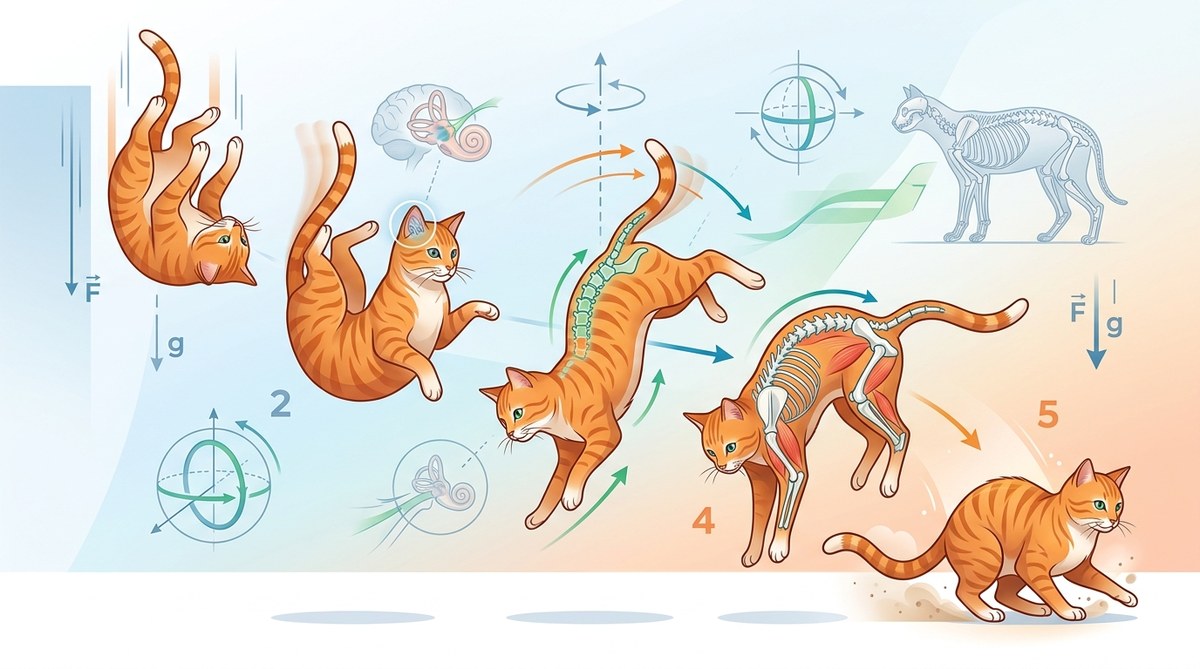
You have seen it happen. A cat slips off a ledge, tumbles through the air, and lands on all four paws as if nothing happened. It looks like magic. But it is not magic. It is a combination of flexible anatomy, fast reflexes, and the laws of physics.
Cats can land on their feet thanks to the feline righting reflex, a sequence of motions that starts within a fraction of a second of falling. Their flexible spine, lack of a collarbone, and keen sense of balance let them twist their body midair without pushing off anything. This reflex works reliably from falls as short as 12 inches.
The Feline Righting Reflex Explained
The official name for this skill is the cat righting reflex. It is an innate ability that kittens begin to develop at around three to four weeks of age. By the time a kitten is seven weeks old, the reflex is fully functional. This is not a learned behavior. It is hardwired into their nervous system.
When a cat falls, its body follows a specific sequence. The cat first determines which way is up using its inner ear. Then it twists its front half, followed by its back half, in opposite directions. This motion rotates the entire body without any external force. The cat does not need to push off a wall or a shelf. It can right itself in midair.
How the Cat Twists Without Pushing Off Anything
This part seems to defy physics. Newton's laws say that to rotate your body, you need to push against something. A diver pushes off the board. A gymnast pushes off the floor. A falling cat has nothing to push against. So how does it turn?
The answer is that a cat can bend its spine in ways humans cannot. A cat has more vertebrae than a person. This gives it a highly flexible backbone. The cat also lacks a rigid collarbone, which allows its shoulders to move independently. By arching its back and tucking in its front legs, the cat creates two separate rotating sections. It twists its front half one way and its back half the opposite way. The two motions cancel each other out, and the whole body rotates. This is called the "bend and twist" maneuver.
The Role of the Inner Ear and Vision
A cat relies heavily on its vestibular system. This is the sensory system in the inner ear that controls balance. When a cat falls, fluid in the inner ear moves and signals the brain about the cat's orientation. The brain then tells the muscles to adjust the body position.
Vision also plays a part. Cats use their eyes to confirm which way is down. However, the righting reflex works even in complete darkness. Studies have shown that cats with damaged inner ears cannot right themselves, but blind cats can. This tells us that the inner ear is the primary sensor for this reflex.
The Step by Step Process of a Cat Falling
Let us break down exactly what happens during a fall. The whole process takes less than a second.
- The cat realizes it is falling. The inner ear detects the change in orientation.
- The cat arches its back to create a bend in the middle of its body.
- The cat tucks its front legs close to its face and rotates its front half toward the ground.
- The back half automatically rotates in the opposite direction to conserve angular momentum.
- The cat extends its front legs to slow the rotation once it faces downward.
- The cat straightens its back legs to prepare for landing.
- The cat lands on all four paws, with legs slightly bent to absorb the shock.
This sequence happens so fast that a cat can right itself in a fall of only 12 inches.
Terminal Velocity and Why Higher Falls Can Be Safer
This is the part that surprises many people. A cat can survive a fall from a greater height than you might expect. In fact, some studies suggest that cats have a better chance of surviving falls from five stories or higher than from two stories.
The reason is terminal velocity. Terminal velocity is the maximum speed an object reaches when air resistance balances gravity. For a cat, terminal velocity is about 60 miles per hour. A human reaches terminal velocity at around 120 miles per hour. Because cats are lighter and have a larger surface area relative to their weight, they fall slower.
When a cat reaches terminal velocity, it stops accelerating. At that point, the cat can relax and spread its body out like a flying squirrel. This increases drag and slows the fall even more. The cat also has time to position itself correctly. A fall from a lower height may not give the cat enough time to fully right itself or absorb the impact.
This does not mean you should test this. High rise syndrome is a real danger for cats in cities. Cats can still suffer serious injuries from falls. But their biology gives them a remarkable advantage.
Common Myths About Cats Landing on Their Feet
There are several misconceptions about this ability. Let us clear them up.
- Cats always land on their feet. This is not true. Cats can fail to right themselves if they are very young, very old, or injured. A fall from a very short distance may not give them enough time to complete the reflex.
- Cats are immune to fall injuries. They are not. Cats can break bones, damage organs, or suffer head trauma from a fall.
- Cats use their tails to steer. The tail helps with balance, but it is not the primary tool for righting. Cats that have lost their tails can still land on their feet.
- A cat will never get hurt if it lands on its feet. Landing on all four paws distributes the force, but it does not eliminate it. Joints and bones still absorb a lot of impact.
A Table of Righting Reflex Success Factors
| Factor | Effect on Righting Reflex |
|---|---|
| Age of cat | Kittens develop the reflex by 7 weeks; older cats may lose coordination |
| Height of fall | At least 12 inches needed; higher falls allow more time to adjust |
| Health of inner ear | Essential for orientation; damaged ears prevent righting |
| Body condition | Overweight cats have a harder time twisting quickly |
| Surface below | Soft ground reduces injury risk; hard surfaces increase it |
Why Cats Are Built for This
Cats are natural predators that climb trees, fences, and walls. Falling is a risk of that lifestyle. Evolution gave them the tools to survive those falls. Their lightweight frame, flexible spine, and powerful leg muscles all contribute.
The cat's skeleton has about 230 bones. A human has 206. The extra bones are mostly in the spine, giving cats 30 vertebrae compared to a human's 24. This extra flexibility allows the dramatic midair twist.
Cats also have a very fast reaction time. Their nervous system processes information and sends signals to muscles in about 30 to 40 milliseconds. That is faster than a human can blink.
What Happens When a Cat Falls From a Great Height
Veterinarians have studied cases of cats falling from apartment windows. This is often called high rise syndrome. Data from these cases shows that cats falling from two to six stories often suffer more injuries than cats falling from seven stories or higher.
Why? Because a cat needs time to reach terminal velocity and relax its body. From a lower height, the cat is still accelerating when it hits the ground. The impact is harder. From a higher height, the cat reaches terminal velocity, spreads out, and hits the ground with a lower effective speed.
"Cats have a remarkable ability to survive falls from extreme heights, but they are not invincible. The best thing you can do for your cat is to install window screens and keep balcony doors closed." - Dr. Sarah Ellis, feline behavior specialist
How You Can Keep Your Cat Safe
You love your cat. You do not want it to fall. Here are practical steps to prevent accidents.
- Install sturdy screens on all windows. Cats push against screens, so use metal mesh rather than flimsy material.
- Keep balcony doors closed or install a cat proof net.
- Do not let your cat play on high, narrow ledges inside the home.
- Provide stable climbing furniture that your cat can grip easily.
- If your cat is overweight, help it lose weight. Extra body fat makes it harder for a cat to right itself.
Cats are skilled at landing on their feet, but they still need your help to stay safe.
The Physics of Falling Cats and Conservation of Angular Momentum
Scientists have studied the cat righting reflex for over a century. Early photographers used high speed cameras to capture the motion frame by frame. These images proved that cats do not push off anything. They use internal body movements.
The key physics concept is conservation of angular momentum. In simple terms, if your body is not touching anything, your total spin cannot change unless you move parts of your body in opposite directions. A cat pulls in its front legs and rotates its front half. The back half rotates the other way. The total angular momentum stays at zero, but the cat's orientation changes.
This is the same principle that lets an ice skater spin faster by pulling in their arms. The cat does the opposite. It extends its legs to slow its rotation.
Why Some Animals Cannot Do This
Not every animal can right itself in midair. Dogs cannot. Rabbits cannot. Humans cannot. The reason is anatomy. Dogs have a less flexible spine and a more rigid shoulder structure. They cannot bend and twist the same way a cat can.
Some other animals do have a righting reflex. Squirrels and some primates can twist in the air, but they are not as efficient as cats. The cat's unique skeleton makes it the champion of midair recovery.
A Final Look at the Feline Superpower
The ability to land on their feet is one of the most impressive adaptations in the animal kingdom. It combines biology, physics, and evolution into a single fluid motion. Cats do not think about it. They just do it.
Next time you see your cat jump down from a tall bookcase, take a moment to appreciate the complex chain of events that just happened. The inner ear detected the fall. The spine bent. The legs tucked. The body twisted. And four paws hit the ground, ready for whatever comes next.
Keep your windows secure, your cat healthy, and your curiosity satisfied. That is the best way to enjoy this remarkable feline talent.
Was this page helpful?
Our commitment to delivering trustworthy and engaging content is at the heart of what we do. Each fact on our site is contributed by real users like you, bringing a wealth of diverse insights and information. To ensure the highest standards of accuracy and reliability, our dedicated editors meticulously review each submission. This process guarantees that the facts we share are not only fascinating but also credible. Trust in our commitment to quality and authenticity as you explore and learn with us.