
Written by: The Editorial Team
Published: 10 Oct 2026
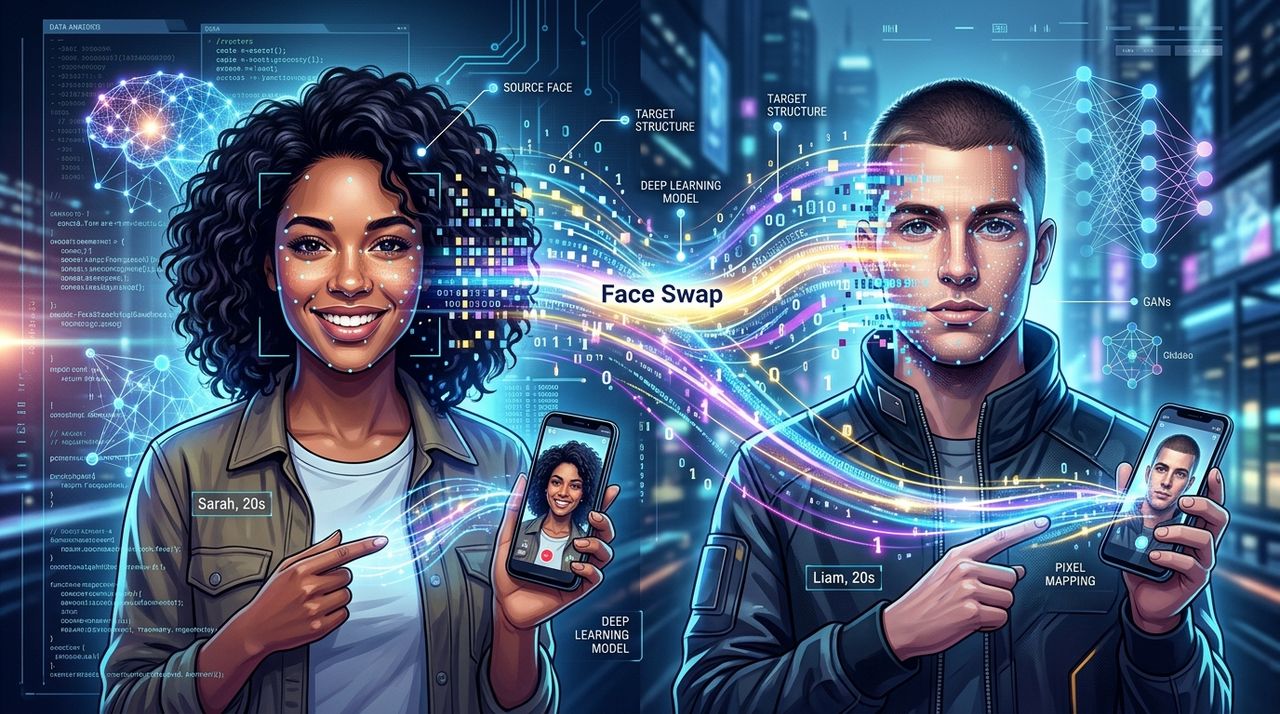
AI face swap has traveled a long road from niche computer vision experiments to something millions of people use every week. The algorithms have matured, the hardware has gotten cheaper, and the gap between cutting-edge research and what you can do in a browser tab has never been smaller. Whether you are curious about the mathematics behind the effect or you want to understand why regulators and platforms are paying close attention, these 20 facts give you a clear, grounded picture of where this technology stands in 2026.
Key Takeaway: AI face swap works by detecting facial landmarks, training generative models on paired image data, and blending synthesized faces into video or photo frames. What started as an academic exercise in university computer vision labs in the early 2010s is now accessible in browser-based tools that need no software installation. The technology raises genuine consent and safety questions that governments, platforms, and standards bodies are actively working to address in 2026.
A Technology Born Long Before the Word "Deepfake" Existed
Fact 1: The earliest automated face-swapping algorithms appeared in computer vision conference papers in the mid-2000s. Researchers were trying to solve identity transfer for film production and animation, not create viral content. The goal was to save studios money on reshoots, not to fool anyone.
Fact 2: Facial landmark detection is the absolute foundation of every face swap pipeline. A landmark detector places dozens of coordinate points on a face, mapping the eyes, nose, mouth corners, jawline, and brow ridge. These points act as an anchor grid so the model knows exactly where to warp, paste, and blend the replacement face onto a new head.
Fact 3: Early landmark detectors relied on hand-engineered features like Histogram of Oriented Gradients combined with regression trees trained on labeled facial images. The process was slow and brittle, breaking down whenever lighting was unusual or a face turned more than about 30 degrees from center.
Fact 4: Consumer interest in automated face swap exploded around 2017 and 2018, driven by mobile apps that could swap two faces in a photo in real time. Those early apps were crude by current standards, often producing smeared edges and mismatched skin tones, but they proved how much public appetite existed for the technology.
The GAN Revolution That Made Faces Look Real
Fact 5: The defining quality leap came when researchers applied generative adversarial networks to the face synthesis problem. A GAN trains two neural networks simultaneously: a generator that creates synthetic face images and a discriminator that tries to tell real faces from fake ones. Over millions of training steps, the generator learns to produce output so convincing that the discriminator can no longer reliably detect it.
Fact 6: GAN-based face swap models learn far more than simple pixel copying. They capture lighting direction, skin tone variation across the face, pore-level texture, and the subtle geometry of how facial muscles compress the skin around the eyes and mouth. The discriminator penalizes any output that looks obviously artificial, which pushes the generator steadily toward photorealism.
Fact 7: One of the most influential architectural approaches is the shared decoder model. A source encoder compresses the identity features of the target face into a compact latent vector, and a decoder reconstructs those identity features onto the geometry of the source face. Both encoder branches share a single decoder, which forces the system to learn a unified internal representation of face structure independent of specific identity.
Fact 8: Training a high-quality face swap model from scratch originally required thousands of photographs of the target person taken from many different angles and lighting conditions. That data barrier was enormous in 2018. By 2026, few-shot learning techniques can generate convincing results from as few as a dozen reference images, which has dramatically lowered the cost of production.
Keeping It Consistent Across Thousands of Video Frames
Fact 9: Swapping a face in a single photograph is a comparatively simple problem. Doing the same across thousands of video frames while keeping the result coherent and smooth is far harder. Early video face swaps flickered noticeably because each frame was processed as an independent image with no memory of the frames around it.
Fact 10: Temporal consistency models address this by conditioning each frame's output on its neighboring frames. The training loss penalizes any flicker or color shift between consecutive frames, which produces the smooth, stable output that makes modern video face swap look believable rather than like a slideshow of slightly mismatched portraits.
Fact 11: Optical flow estimation is frequently combined with the face swap model to track how facial features move between frames. Flow fields describe the direction and speed of every pixel's motion, which helps the system preserve natural head movement and prevents the swapped face from drifting or sliding in a way that immediately reads as artificial.
Fact 12: Real-time face swap, where your face is replaced live during a video call, became practically viable for consumers around 2023. Model compression techniques including knowledge distillation and INT8 quantization reduced model sizes enough to run inference at 30 frames per second on ordinary consumer hardware. By 2026, a mid-range laptop can handle real-time face swap locally, without any cloud connection.
Consent, Law, and Platform Enforcement in 2026
Fact 13: The ethical and legal landscape has grown considerably more complex. As the deepfake entry on Wikipedia documents in detail, non-consensual synthetic media, especially intimate imagery, has caused documented harm to real individuals around the world, which has pushed the issue firmly onto legislative agendas.
Fact 14: As of 2026, the United States, the European Union, the United Kingdom, South Korea, and Australia have all enacted or are actively enforcing laws that specifically target non-consensual synthetic media. Penalties vary by jurisdiction and severity but include civil damages, criminal charges, and mandatory content removal orders against platforms that fail to act.
Fact 15: Consent standards in professional film and television have formalized substantially. Major entertainment guilds including SAG-AFTRA now negotiate explicit provisions around digital likeness rights into their collective agreements. Studios that want to use face swap technology to de-age an actor, replace a stunt performer, or recreate a deceased performer's likeness must obtain contractual permission and pay negotiated compensation.
Fact 16: Platform safety policies have moved from vague prohibitions on "deceptive content" toward specific, enforceable rules about synthetic media. Most major video-sharing services, social networks, and messaging platforms now require creators to label synthetic or AI-altered content. Undisclosed face swaps that could mislead viewers about whether they are watching a real person are removable under community standards, and repeat violations lead to account suspension.
Fact 17: Detection technology has matured into a core part of content moderation infrastructure. Academic research groups and AI safety companies publish open-source deepfake detection classifiers, and several major platforms use these models to flag potentially synthetic content for human review before it reaches a wide audience.
How Accessible Face Swap Has Become in 2026
Fact 18: The most significant shift of the last two years is how little technical knowledge a person needs to use face swap technology. In 2026, you do not need a GPU, a local Python environment, or any training data. A browser-based face swap tool that runs entirely in the cloud and returns results in seconds is a concrete illustration of how far the technology has traveled from its academic origins, where running a single experiment once required days of compute time on university hardware.
Fact 19: Mobile devices have become the dominant platform for casual face swap. Most popular apps run neural network inference directly on the device using optimized formats like ONNX or Apple's CoreML, which means the user's facial data never leaves their phone. Privacy-conscious users in 2026 increasingly check for on-device processing as a baseline signal that an application is handling their biometric data responsibly.
Fact 20: Provenance and watermarking standards are being embedded directly into the generation pipeline. The Content Authenticity Initiative and the C2PA specification allow synthetic images and videos to carry a cryptographically signed manifest that records when and how the content was created. Several consumer face swap tools already attach C2PA manifests automatically, giving downstream viewers a verifiable way to confirm they are looking at AI-generated content rather than authentic footage.
What These 20 Facts Tell Us About Where the Technology Is Headed
AI face swap is no longer a curiosity tucked inside research papers. It is a mainstream capability shaped by decades of computer vision progress, accelerated by adversarial training, and now embedded in tools that anyone with a browser can use without reading a technical manual. The same accessibility that makes the technology genuinely useful for filmmakers, educators, and creative professionals also makes the consent and safety questions more pressing than ever. Regulation, platform policy, detection systems, and provenance standards are all advancing, but the technical pace shows no sign of slowing. Understanding these 20 facts puts you in a much better position to think clearly about a technology that will keep appearing in news headlines, policy debates, and your social media feed for years to come.
Was this page helpful?
Our commitment to delivering trustworthy and engaging content is at the heart of what we do. Each fact on our site is contributed by real users like you, bringing a wealth of diverse insights and information. To ensure the highest standards of accuracy and reliability, our dedicated editors meticulously review each submission. This process guarantees that the facts we share are not only fascinating but also credible. Trust in our commitment to quality and authenticity as you explore and learn with us.