
Written by: The Editorial Team
Published: 30 Oct 2026
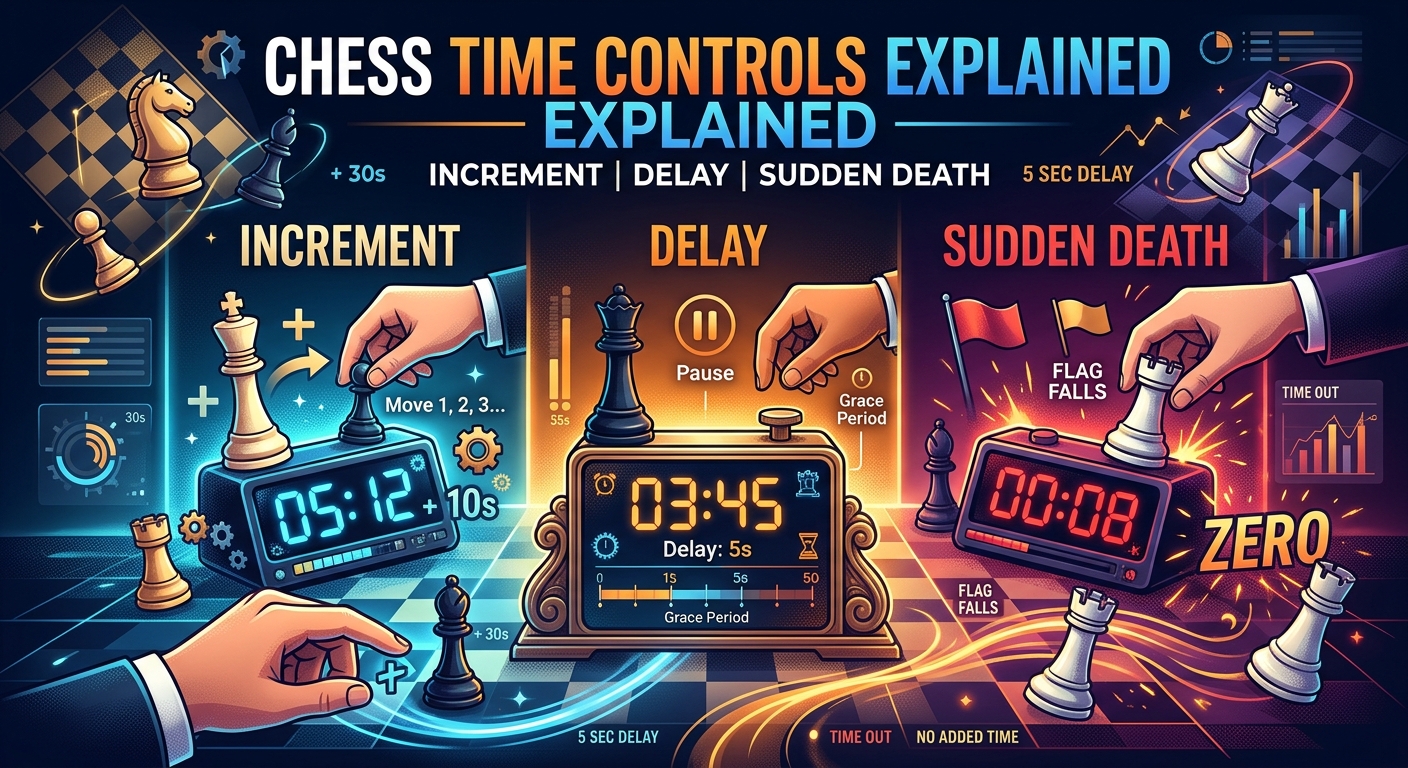
You have one minute left on your chess clock. You take three seconds to move, press the button, and look down. Your display might show 57 seconds, one minute, or one minute and two seconds. Each result can be correct. The difference comes from the timing system, which determines how thinking time is spent, protected or added.
Three Clock Facts to Know
- Increment adds a fixed amount of time for each completed move.
- Simple delay protects the opening seconds of each turn without saving unused protection.
- Sudden death requires every remaining move to fit within the final time period.
1. A Chess Clock Measures Each Player’s Time Separately
A chess clock has two linked timers, one for each player. During ordinary play, your timer runs while you consider and make your move. Pressing the clock stops your timer and starts your opponent’s.
The starting allowance belongs to each player individually. A game advertised as ten minutes per player gives White ten minutes and Black ten minutes. It does not give them ten minutes to share.
That distinction also explains why starting time alone cannot tell you exactly how long a game will last. An early checkmate can end play with time remaining. Added seconds can extend play beyond the combined starting allowances.
For physical chess, moving a piece and pressing the clock are separate actions. Time spent reaching for the button normally remains part of your turn. The timing examples below include the full interval before that press.
2. Increment Adds Seconds You Can Keep
Increment gives a player a fixed time addition for each completed move. A common example is 10+5. In standard increment notation, that means ten starting minutes per player, with five seconds added per move.
Consider a turn that begins with 60 seconds available. You spend three seconds making your move and pressing the clock. The timer spends three seconds, then receives five. You finish with 62 seconds.
If that turn takes eight seconds instead, you finish with 57 seconds. The addition remains five seconds regardless of how much time you used, provided you complete the move before your time expires.
This is the defining feature of increment: saved additions remain available for later moves. Several fast turns can build a reserve for a difficult position. Increment is also known as Fischer timing.
Clock displays can handle the initial addition differently, including making it available before the first move. Check the device’s settings and the event’s stated control. For the examples here, each starting balance is the amount available at the beginning of the illustrated turn.
3. Simple Delay Protects Time Without Building a Reserve
Simple delay gives you a protected interval at the beginning of each turn. Your main time starts decreasing only after that interval expires.
Take the same 60-second balance with a five-second delay. If you complete your turn in three seconds, your main balance stays at 60 seconds. The unused two seconds of delay disappear.
If you take eight seconds, the first five seconds are protected. The remaining three come from your main balance, leaving 57 seconds.
The assigned guide to increment versus delay makes the key distinction clear: increment can increase the main balance, while unused simple delay cannot accumulate. Both offer breathing room, but they account for that time differently.
A delay clock may display a separate countdown or hold the main display steady during the protected interval. A display that briefly stays unchanged does not necessarily mean the clock has stopped working.
4. The Same Move Can Produce Different Balances
A direct comparison makes the arithmetic easier to follow. Each example below starts with 60 seconds available. The increment and delay allowances are both five seconds. Assume the move is completed before time expires.
Time Remaining After a Three-Second or Eight-Second Turn
| Timing Method | After Three Seconds | After Eight Seconds | Can Saved Time Accumulate? |
|---|---|---|---|
| No addition or delay | 57 seconds | 52 seconds | No new time is supplied. |
| Five-second increment | 62 seconds | 57 seconds | Yes, unused additions remain. |
| Five-second simple delay | 60 seconds | 57 seconds | No, unused delay expires. |
Notice that increment and delay give the same result after the eight-second turn. Their difference appears when a player uses less than the allowance. Increment lets that player keep the difference. Delay simply preserves the existing balance.
5. Bronstein Timing Returns Time Already Spent
Bronstein timing is another method readers may encounter on a digital clock. It refunds time after a completed move, up to a specified limit. The refund cannot exceed the time used on that turn.
With a five-second refund limit, a three-second turn receives three seconds back. An eight-second turn receives five seconds back. Starting from 60 seconds, those examples finish at 60 and 57 seconds respectively.
Those balances match the simple-delay examples, but the display sequence can differ. A Bronstein clock may count down immediately and return time after the press. A simple-delay clock protects the opening interval before reducing the main balance.
Clock terminology can vary. Check the named mode and its instructions instead of assuming that every setting called “bonus” works the same way. A short trial before play can reveal how the display accounts for time.
6. Sudden Death Means No Later Time Period Awaits
Sudden death describes a deadline for completing the game. Every remaining move must fit within the final time period. There is no later move target that releases another block of main time.
A straightforward example gives each player 15 minutes for the whole game, without increment or delay. After using 14 minutes, a player has one minute left for every remaining move. Reaching move 40 does not produce a fresh allowance.
The term can cause confusion because it describes a different feature from increment or delay. Sudden death identifies the final period. Increment and delay describe how the clock handles individual turns. A final sudden-death period can therefore include increment or delay if the stated control provides it.
For clarity, read the complete timing instructions. “All moves in 15 minutes, no addition or delay” says more than “sudden death” alone.
7. Staged Controls Add Time at a Move Target
Some games divide the allowance into stages. A hypothetical control might give each player 60 minutes for 40 moves, followed by 30 minutes for all remaining moves.
The first period requires each player to complete 40 moves within their allowance. Reaching that target brings the next block of time under the stated control. The final 30-minute period covers the rest of the game.
This differs from increment. A stage supplies a larger block at a specified point. Increment supplies a small amount repeatedly. A control may use both, but the event instructions must specify when each applies.
Unused time can carry into the next period where the rules provide for it. A player who reaches the target with time remaining may therefore begin the next stage with more than the newly added block.
8. Read the Whole Control Before Starting
Numbers are useful shorthand, but they need context. A plus sign commonly identifies increment, with starting time in minutes and the addition in seconds. Delay should be stated explicitly.
- 10+5: ten starting minutes per player with a five-second increment.
- 10 minutes with five-second delay: ten main minutes per player, protected by a fresh five-second interval each turn.
- 15 minutes, no addition or delay: a fixed allowance for the whole game.
- 40 moves in 60 minutes, then 30 minutes to finish: a staged control with a final period.
Do not assume that five seconds has the same meaning in every format. Confirm whether it is added, protected or refunded. Also check whether the allowance applies from move one or begins at a later stage.
9. Running Out of Time Has a Specific Rule
Time expiration is often called flag-fall, a term inherited from mechanical clocks. In ordinary circumstances, failing to complete the required moves within the allotted time loses the game.
There is a relevant exception. Under official chess rules, the result is a draw if the opponent cannot checkmate through any possible series of legal moves. This is a stricter question than whether checkmate seems likely.
An increment does not rescue a player who has already run out of time before completing the move. The next addition depends on completing the turn in time. Delay also requires the player to finish before the available protected interval and main time are exhausted.
Make Every Second Accountable
Before a game, try two sample turns on the chosen setting. Finish one inside the allowance and let another run beyond it. Watch the main balance before and after each press.
If fast moves increase the balance, you are seeing increment. If the main balance stays still during an opening interval, you are seeing simple delay. If spent time returns after the press, check for a refund mode. Finally, confirm whether another time period follows or every remaining move must fit into the current one. Those checks turn an unfamiliar clock into a readable part of the game.
Was this page helpful?
Our commitment to delivering trustworthy and engaging content is at the heart of what we do. Each fact on our site is contributed by real users like you, bringing a wealth of diverse insights and information. To ensure the highest standards of accuracy and reliability, our dedicated editors meticulously review each submission. This process guarantees that the facts we share are not only fascinating but also credible. Trust in our commitment to quality and authenticity as you explore and learn with us.