
Written by: The Editorial Team
Published: 23 Aug 2026
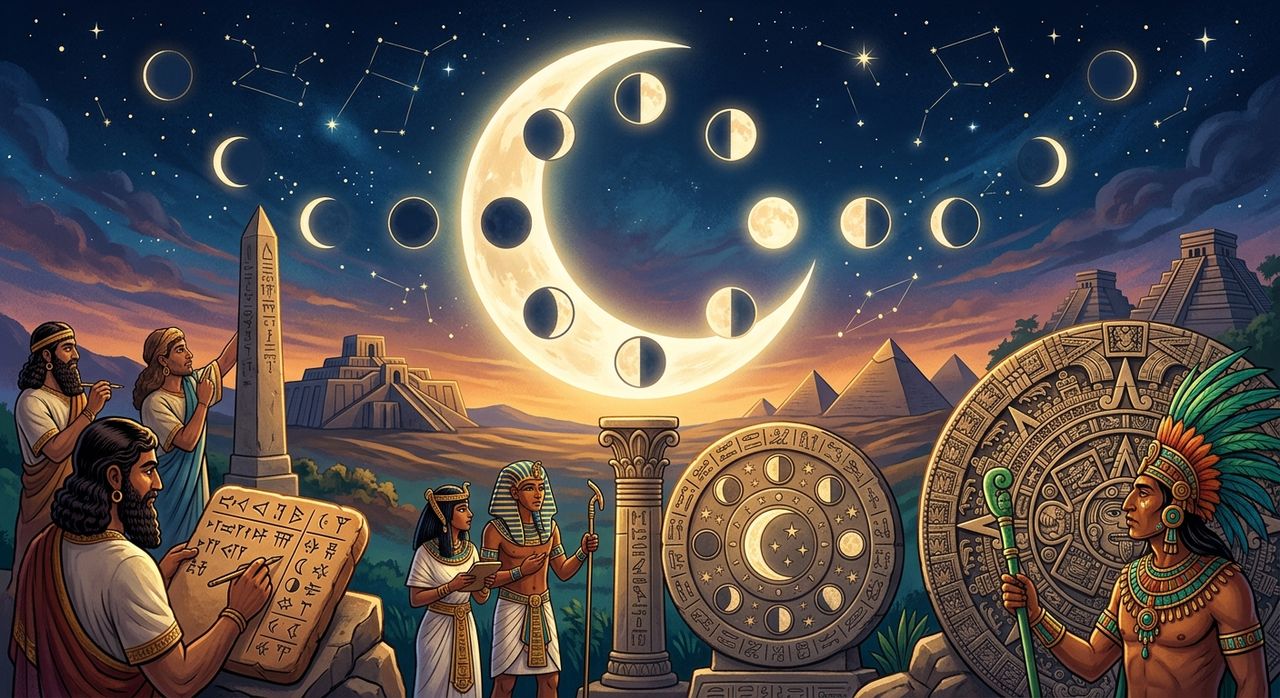
Long before printed planners, atomic clocks, or written records, ancient humans had one reliable clock hanging above them every night. The moon rose, swelled into a bright disc, faded to a sliver, and disappeared, only to start all over again. That predictable rhythm, a cycle of roughly 29 and a half days, gave our ancestors something they desperately needed: a way to count time. Civilizations from Mesopotamia to China built their entire year around it, and the moon's grip on human timekeeping has never fully loosened.
Key Facts About Lunar Calendars:
- The moon completes a full cycle from new moon to new moon in approximately 29.5 days
- Babylonians were among the first to formalize a lunar month-based calendar, around 2000 BCE
- The Islamic, Hebrew, and Chinese calendars all still use the lunar cycle as their foundation
- A purely lunar year runs about 11 days shorter than a solar year, creating a drift problem that ancient cultures solved in different ways
- Major observances including Ramadan, Passover, and the Lunar New Year are all still timed by the moon
Why the Moon Made More Sense Than the Sun
The sun tells you what time of day it is, but it offers almost no help when you want to count days or months. You cannot watch the sun change shape. The moon is completely different. Its phases are dramatic and unmistakable. A crescent grows into a half-moon, then a full moon blazing against the night sky, then it shrinks back to nothing. Ancient people could track this cycle without any instruments at all. All they needed was a pair of eyes and patience.
This is why lunar timekeeping almost certainly predates solar timekeeping by thousands of years. Some researchers believe that tally marks found on animal bones, dating back 20,000 to 30,000 years, were early attempts to track the lunar cycle. Whether those marks represent precise lunar calendars is still debated by archaeologists, but the impulse behind them is clear. Humans wanted to count the moon. They needed to predict when it would return, when tides would surge, when certain animals would be active, and when the next planting window might open.
The Babylonians and the Birth of the Formal Lunar Month
The Babylonians of ancient Mesopotamia were among the first to turn lunar observation into a proper administrative system. By around 2000 BCE, they had built a calendar on twelve lunar months, alternating between 29 and 30 days to account for that awkward 29.5-day average. Priests watched the western sky each evening for the first sliver of a new crescent moon. When they spotted it, a new month officially began.
Their system was not purely religious. It was deeply practical. Merchants dated contracts by it. Farmers planned planting and harvesting around it. Tax collectors scheduled payments to it. The lunar month was the basic unit of civic life in a way that is genuinely hard to imagine today.
The problem the Babylonians recognized early on is that twelve lunar months add up to only about 354 days, not 365. That shortfall of roughly 11 days means a purely lunar calendar drifts through the solar year. After a few years, a calendar that started in what we call January would slide into summer. To correct this, Babylonian astronomers inserted an extra month in certain years, a practice called intercalation. They eventually worked out a 19-year pattern, now called the Metonic cycle, in which seven extra months are inserted across nineteen years. This brings the lunar and solar calendars back into near-perfect alignment, within about two hours of precision across that entire span.
The Islamic Calendar: Purely and Proudly Lunar
The Islamic calendar, formalized in the seventh century CE, made a deliberate and bold choice. It kept the lunar system pure and refused to add any corrective months. The Islamic year contains twelve lunar months and nothing more. This means Islamic observances rotate backward through the solar year, completing a full rotation in about 33 years.
This is why Ramadan, the holy month of fasting, falls in a different season every decade. Some years it lands in winter, when short days make fasting more manageable. Other years it arrives in the height of summer, stretching fasts past sixteen or eighteen hours in northern latitudes. For Muslims around the world, that shifting relationship with the seasons carries spiritual meaning. Over a lifetime, every Muslim will experience Ramadan in every season, a form of equality across time.
The Islamic calendar is one of the clearest examples of a civilization consciously prioritizing religious coherence over agricultural convenience.
The Hebrew Calendar: Splitting the Difference
The Hebrew calendar takes a different path. It is technically a lunisolar calendar, meaning it uses lunar months as its basic unit but adds extra months to keep the calendar aligned with the solar year. The same Metonic 19-year cycle that Babylonian astronomers developed is still in use today. According to calendar intercalation records, the current standardized system was established in the fourth century CE, replacing earlier methods where official witnesses had to report a new crescent moon to religious authorities before a month could begin.
This is why Jewish holidays like Passover always fall in spring, even though they are calculated from the lunar cycle. Passover must occur in the month of Nisan, which is kept close to the spring equinox by the intercalation system. The same logic keeps Rosh Hashanah in autumn and Hanukkah in winter. The Hebrew calendar manages to feel both lunar and seasonal at the same time, which is a remarkable accomplishment of ancient astronomical thinking.
The Chinese Lunar Calendar: Where the Moon Meets the Seasons
The Chinese traditional calendar is another lunisolar system, and it remains in active use across East and Southeast Asia for festivals and agricultural guidance. Like the Hebrew calendar, it uses lunar months but inserts leap months to track the solar year. The Chinese New Year falls on the second new moon after the winter solstice, which is why it moves between late January and mid-February on the Gregorian calendar each year.
What makes the Chinese system particularly fascinating is its parallel structure for farming. The calendar includes 24 solar terms, specific points in the solar year that mark transitions in the agricultural cycle, from the start of planting season to the peak of summer heat to the arrival of frost. Lunar months and solar terms coexist in the same system, giving farmers two interlocking frames of reference. It is a beautifully pragmatic solution to the problem of serving both religious and agricultural needs at once.
The 29.5-Day Problem and Why It Drove Ancient Science Forward
That fractional half-day in the lunar cycle causes far more trouble than it might seem. You cannot simply alternate 29-day and 30-day months indefinitely and stay synchronized with the actual moon. Over decades and centuries, small errors accumulate. Nearly every culture that used a lunar calendar eventually had to invest in serious astronomical study to stay in sync.
This pressure drove genuine scientific advances. Babylonian astronomers developed mathematical models of the moon's movement that were strikingly accurate for their era. Greek astronomers built on those models and refined them further. The Metonic cycle itself represents a real mathematical discovery, the recognition that 235 lunar months equals almost exactly 19 solar years. Ancient people calculated this without telescopes, without computers, and without any of the tools we take for granted today.
The Moon in Modern Life
The moon's role as a timekeeper has not faded, even though most of the world now runs on the Gregorian solar calendar. Hundreds of millions of people still observe lunar or lunisolar religious calendars. The dates of Eid al-Fitr, Eid al-Adha, Ramadan, Passover, Rosh Hashanah, Diwali, the Lunar New Year, and dozens of other major observances are all still calculated from lunar cycles.
Farming communities in many parts of the world continue to plant and harvest by the moon. Biodynamic agriculture, which has attracted renewed interest in recent decades, uses a planting calendar based on lunar phases. Fishing communities in coastal regions track the moon for its tidal influence and its effect on fish behavior. Even hobbyist gardeners sometimes consult a lunar planting guide before sowing seeds.
Lunar calendar history makes clear that the moon has served as humanity's most consistent shared clock, running across cultures that otherwise had almost nothing in common. If you want to connect that long historical tradition to something immediately practical, tracking current moon phases alongside your own schedule gives you the same frame of reference that farmers, priests, and merchants have used for thousands of years.
A Light That Still Sets the Pace
The Gregorian calendar may run the modern world, but it sits on top of thousands of years of lunar timekeeping. Most of the world's major religious observances still follow the moon. Billions of people celebrate new years, fasting periods, and harvest festivals on dates the moon determines. The system that a Babylonian priest worked out by watching the horizon 4,000 years ago is still shaping what day billions of people consider sacred, celebratory, or significant.
The moon did not just inspire ancient calendars. For much of humanity, it is still the clock by which real life is actually lived.
Was this page helpful?
Our commitment to delivering trustworthy and engaging content is at the heart of what we do. Each fact on our site is contributed by real users like you, bringing a wealth of diverse insights and information. To ensure the highest standards of accuracy and reliability, our dedicated editors meticulously review each submission. This process guarantees that the facts we share are not only fascinating but also credible. Trust in our commitment to quality and authenticity as you explore and learn with us.