
Written by: The Editorial Team
Published: 2 Sep 2026
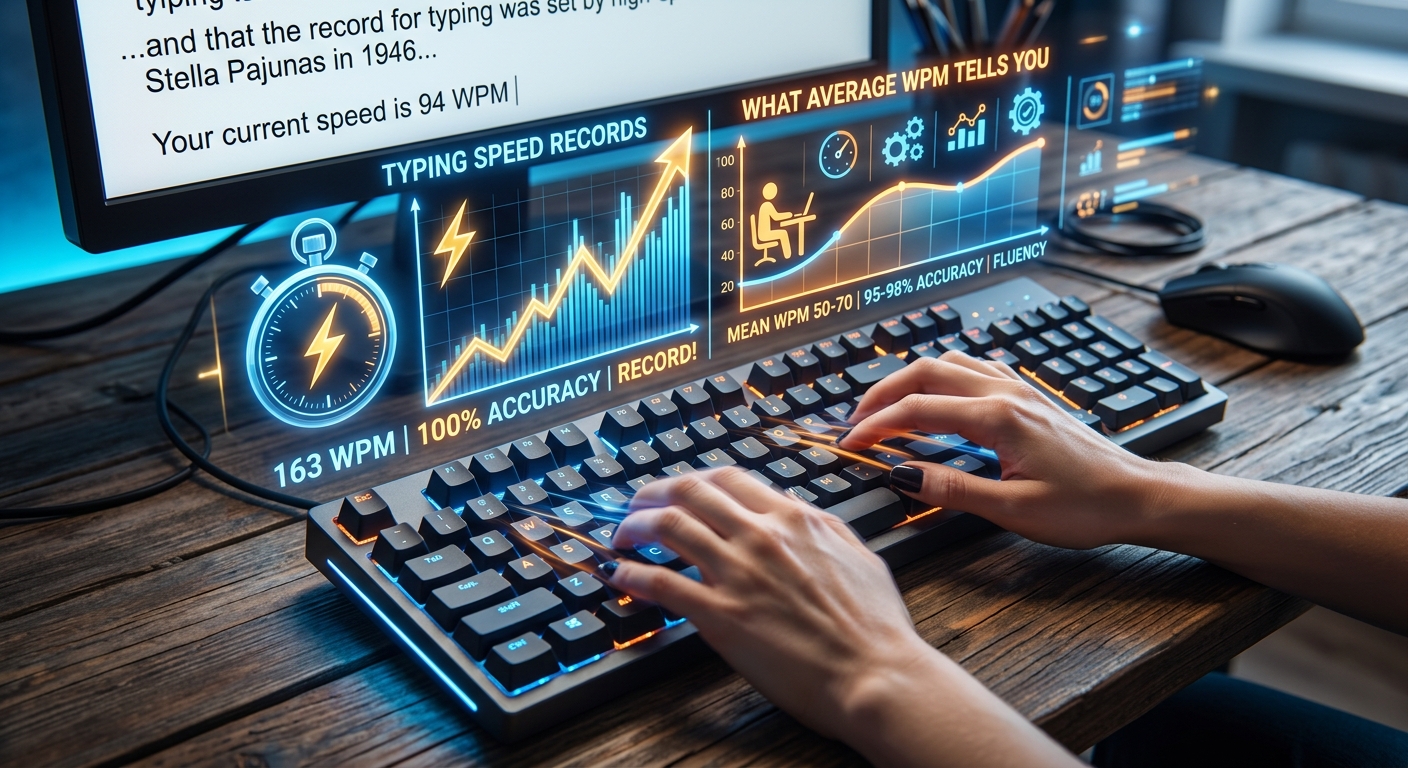
Most people have no idea how fast they actually type. They just type. They send emails, fill in forms, write reports, and never stop to measure the thing their fingers do automatically every single day. But the moment you put a number on it, something interesting happens. You start to wonder: is that good? Is that fast? Am I above average, or embarrassingly slow?
Key Takeaway: Typing speed is far more nuanced than a single WPM score suggests.
- World-record speeds exceed 200 WPM, but the average office worker types between 38 and 45 WPM.
- Different jobs demand very different speeds, and transcriptionists often sustain 75 to 100 WPM professionally.
- Beyond roughly 60 to 70 WPM, accuracy becomes a bigger productivity factor than raw speed.
The Numbers That Broke the Record Books
The verified world record for typing speed is genuinely astonishing. Barbara Blackburn held the Guinness World Record for the fastest typing on a standard keyboard, reaching a peak burst of 212 words per minute on a Dvorak layout. Her sustained speed over a longer period hovered around 150 WPM, which is still more than three times faster than the average person.
More recently, competitive typists on platforms like TypeRacer have posted verified scores above 200 WPM on standard QWERTY keyboards. These are not flukes. These are people who have trained for years, who understand rhythm and finger placement at a level most of us never bother to think about.
The standard unit used to measure typing speed, words per minute, is typically calculated using a standardized "word" of five characters, including spaces. This means "a" counts the same as "the" in raw calculation, which is one reason WPM scores can shift dramatically depending on the text being typed.
What Average Actually Looks Like
Average WPM is not a single clean number. It depends heavily on who you are asking and what they do for a living.
Here is how different professional groups tend to cluster:
- General office workers average between 38 and 45 WPM. This group includes people who type regularly but were never specifically trained on speed.
- Programmers and developers typically land between 55 and 65 WPM. The nature of coding rewards accuracy over long bursts, so deliberate habits tend to push this group above the general average.
- Administrative assistants and data entry workers often reach 60 to 80 WPM, since speed is a measurable part of their daily performance.
- Transcriptionists are the outliers. Professionals in medical or legal transcription are often expected to maintain 75 to 100 WPM accurately, for extended periods without breaks.
These ranges tell you something real: the jobs that reward typing speed tend to produce faster typists over time. Skill follows incentive.
Why Accuracy Beats Speed Past a Certain Point
Here is the finding that surprises most people. Once you cross roughly 60 to 70 words per minute, raw speed stops being the most important variable. Accuracy takes over.
Think about it this way. If you type at 80 WPM with a 95% accuracy rate, you are generating a meaningful number of errors per minute. In a 500-word document, that could mean 25 mistakes to fix. Corrections cost time. Every backspace you hit is a speed penalty that your raw WPM score never captures.
A typist at 65 WPM with 99% accuracy will often outperform someone at 85 WPM with 94% accuracy in real-world productivity terms. The net output, after corrections, tends to favor the accurate typist once you factor in revision time.
This is not just theory. Typing test scores are increasingly reported as net WPM, which subtracts error penalties from the gross speed. Net WPM gives a far more honest picture of what someone actually produces per minute.
Professional typing courses have known this for decades. Speed training without accuracy training builds a habit that eventually hits a ceiling. You get fast at typing the wrong letters quickly. The ceiling is not a skill ceiling. It is a precision ceiling.
The Biology Behind Your Finger Speed
There is a hard biological constraint that rarely gets discussed. No matter how much you practice, your maximum possible typing speed is partly limited by the time it takes for your fingers to physically respond to your brain's signal.
Your reaction time and finger-to-key reflex latency set an absolute ceiling on WPM that practice alone cannot push past. The average human reaction time sits around 200 to 250 milliseconds. At peak burst speeds of 200 WPM, elite typists are pressing keys roughly every 150 milliseconds. They are not consciously reacting to each keypress individually. They are running pre-learned motor programs, where entire common letter sequences fire as a single practiced movement rather than a series of deliberate decisions.
This is the same mechanism behind a pianist playing fast scales. The individual notes are not decided one at a time. They are executed as a learned chunk. Elite typists do the same with common words and letter combinations, which is why their WPM scores on common English text tend to be dramatically higher than on randomly shuffled strings or uncommon vocabulary.
Understanding this also explains why Dvorak layouts appeal to some speed typists. By placing the most common letters on the home row, Dvorak reduces finger travel distance, which lowers the time constraint imposed by physical movement rather than neural processing speed.
Where Do You Actually Rank?
Most people who test their typing speed for the first time are genuinely surprised by the result. Either they are faster than expected, or they realize they have been mentally inflating their own ability for years.
The population distribution of typing speeds is right-skewed. Most people cluster between 40 and 60 WPM, with a long tail of skilled typists pulling the average upward. Seeing your score mapped on a WPM percentile chart built from real test-taker data is a much more grounding experience than comparing yourself to a textbook estimate. You can see exactly where you fall in the actual human distribution.
If you land at the 50th percentile, you are average. At the 80th percentile, you are genuinely fast for a non-specialist. Above the 95th percentile, you are approaching a level of skill that most people will never reach regardless of how long they have been typing.
Why Practice Still Shifts the Numbers
Most adults assume their typing speed is fixed. It is not. Even modest deliberate practice, focused specifically on accuracy and common letter patterns, can push someone from 45 WPM to 65 WPM in a matter of weeks. The early gains come fast. The later gains require sustained effort and patience.
Finger placement matters enormously. Typists who use all ten fingers in the correct home row positions consistently outperform self-taught hunt-and-peck typists, even experienced ones. The physics simply favor spreading the work across more fingers.
Text variety matters too. Typing the same sample repeatedly inflates your score without building a transferable skill. Training on diverse text, including names, numbers, punctuation, and unusual words, builds a more honest ability that holds up in real work environments.
And starting with accuracy before chasing speed pays off in the long run. Trying to type faster before reducing your error rate is the most common mistake new speed typists make. You end up cementing bad habits at higher speeds, and unlearning them later is harder than building them correctly from the start.
Speed Is the Story, Accuracy Writes the Ending
Typing speed records grab attention because the numbers are surprising. Two hundred words per minute sounds impossible until you understand what it actually takes to get there. But the practical lesson buried inside all of this is quieter and more useful: speed is the headline, accuracy is what determines whether your work is actually usable at the end of the day.
The world-record holders, the professional transcriptionists, and the fast developers all share one habit. They stopped chasing the WPM number and started caring about consistency. The speed followed.
Your fingers are already faster than you think. The question is just whether they are sending the right signals.
Was this page helpful?
Our commitment to delivering trustworthy and engaging content is at the heart of what we do. Each fact on our site is contributed by real users like you, bringing a wealth of diverse insights and information. To ensure the highest standards of accuracy and reliability, our dedicated editors meticulously review each submission. This process guarantees that the facts we share are not only fascinating but also credible. Trust in our commitment to quality and authenticity as you explore and learn with us.