
Written by: The Editorial Team
Published: 24 Oct 2026
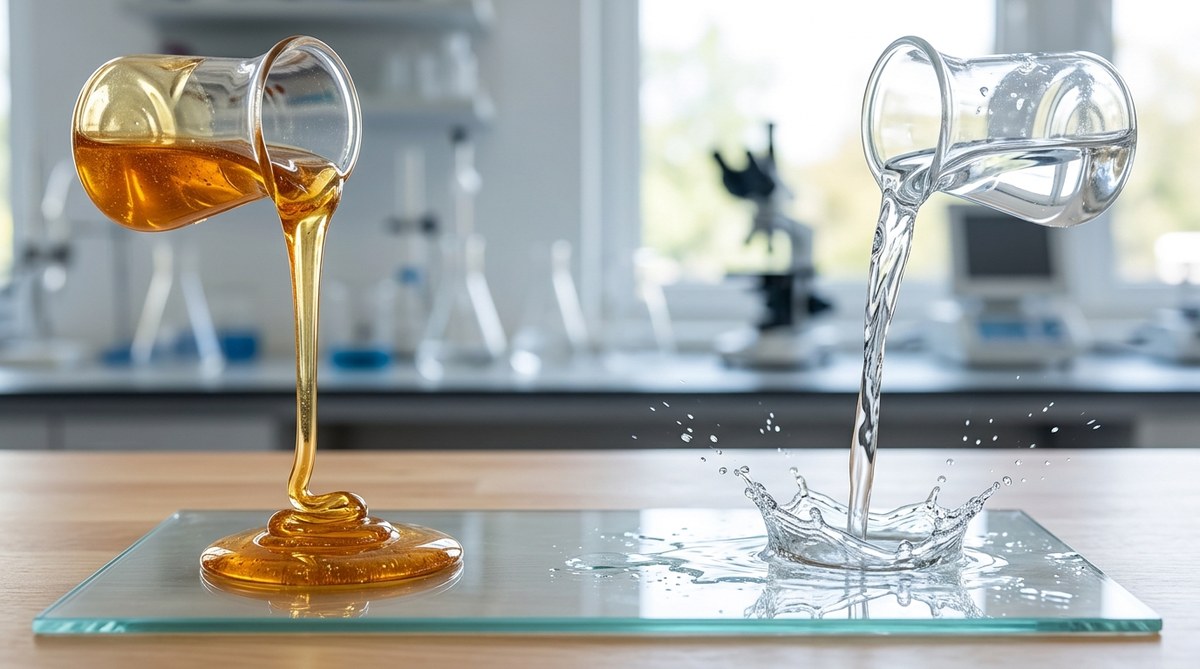
Pour honey on a stack of pancakes and it moves in a slow, lazy ribbon. Splash water on the same plate and it races away in a split second. This everyday difference between honey and water is one of the best examples of a physical property called viscosity. But why is honey so much thicker? The answer lies in how the molecules inside each liquid interact with each other. And once you understand that, you will start seeing viscosity everywhere, from the ketchup bottle in your fridge to the motor oil in your car.
Honey is more viscous than water because its long sugar molecules and complex structure create strong internal friction, making it resistant to flow. Water's small, simple molecules slide past each other easily. Viscosity measures this internal resistance, and it changes dramatically with temperature, which is why warm honey pours much faster than cold honey.
What is viscosity in plain language
Viscosity is a measure of a fluid's resistance to flow. Think of it as the internal friction inside the liquid. When you stir a cup of water, the spoon moves with almost no effort. When you stir a jar of honey, you feel a much stronger drag. That drag is viscosity at work.
Scientists define viscosity as the ratio of shear stress to shear strain rate, but you do not need the math to grasp the concept. A more intuitive way is to picture the molecules inside the liquid. In a low viscosity fluid like water, the molecules are small and move past each other with little resistance. In a high viscosity fluid like honey, the molecules are larger and more tangled, so they create more friction as they slide against one another.
The molecular reason honey is more viscous than water
Water is made of simple H2O molecules. Each molecule is tiny, consisting of just two hydrogen atoms bonded to one oxygen atom. These molecules are so small that they slip past each other with very little resistance. The hydrogen bonds between water molecules do create some stickiness, which is why water has a measurable viscosity, but those bonds break and reform in a fraction of a second.
Honey is a completely different story. Honey is a supersaturated solution of sugars, primarily fructose and glucose, along with other complex carbohydrates and enzymes. These sugar molecules are much larger than water molecules. A single sugar molecule can contain dozens of atoms arranged in rings and chains. When these large molecules try to move past each other, they bump into one another, tangle up, and create a lot of internal friction.
The table below summarizes the key differences:
| Property | Water | Honey |
|---|---|---|
| Main molecules | H2O (tiny, simple) | Fructose, glucose, sucrose (large, complex) |
| Molecular size | Very small | Much larger |
| Internal friction | Low | High |
| Viscosity at room temp | ~1 mPa·s | ~2,000 to 10,000 mPa·s |
| Effect of warming | Viscosity drops slightly | Viscosity drops significantly |
That last row is important. When you heat honey, the molecules vibrate faster and the weak bonds between them break more easily. The viscosity drops sharply, which is why warm honey pours like a liquid while cold honey barely moves. Water also becomes less viscous when heated, but the change is much less dramatic.
How temperature changes the flow of honey
Temperature is the most powerful control knob for viscosity. You have probably noticed this yourself. A jar of honey straight from the refrigerator is almost solid. It takes effort to scoop it out. But if you warm the same jar in a bowl of hot water, the honey becomes runny and easy to pour.
This happens because heat energy makes the molecules move faster. In cold honey, the large sugar molecules are packed closely together and hold onto each other through hydrogen bonds. When you add heat, those bonds break more easily, and the molecules gain enough energy to slide past one another.
Here are three practical ways to use this knowledge:
- Warm honey before measuring it for a recipe. Place the sealed jar in a bowl of warm tap water for about ten minutes. This will make the honey flow more easily and give you a more accurate measurement.
- Store honey at room temperature, not in the fridge. Cold honey becomes extremely thick and difficult to use. A cool pantry is ideal.
- If honey crystallizes and becomes grainy, warm it gently in a water bath. The heat will dissolve the sugar crystals and restore the liquid state.
Common mistakes people make when comparing viscosity
Many people assume that viscosity is the same as density. Density measures how much mass is packed into a given volume, while viscosity measures how easily a fluid flows. Mercury is very dense but flows easily, while honey is less dense than mercury but much more viscous.
Another common mistake is thinking that all thick liquids are highly viscous. Some liquids appear thick because of their surface tension or because they contain suspended particles, but they may actually flow quite easily under pressure. Cornstarch mixed with water is a good example. It feels thick when you poke it, but it flows like a liquid when you pour it.
A third mistake is ignoring the role of temperature. Many people compare the viscosity of honey and water at room temperature and assume the ratio stays the same. But if you chill water to near freezing and heat honey to near boiling, the viscosities can become much closer. Understanding this is useful in real world situations.
"Viscosity is not a fixed number for any fluid. It changes with temperature, pressure, and sometimes even with how fast you stir it. Always consider the conditions when you compare two fluids." - Dr. Maria Chen, fluid dynamics researcher at MIT
Why viscosity matters beyond the kitchen
Viscosity is not just a kitchen curiosity. It plays a critical role in many areas of science and engineering. Engine oil, for example, is designed to have a specific viscosity so it can lubricate moving parts without dripping away too quickly. If the oil is too thin, it will not protect the engine. If it is too thick, it will not flow into all the narrow gaps.
In medicine, blood viscosity is an important health indicator. Thicker blood puts more strain on the heart and increases the risk of clots. Doctors monitor viscosity to assess cardiovascular health.
In manufacturing, the viscosity of paints, inks, and adhesives determines how they spread and dry. A paint that is too viscous will leave brush marks. One that is too thin will drip and run.
Even the natural world depends on viscosity. The way lava flows from a volcano, the speed of a river, and the movement of magma beneath the Earth's crust are all governed by viscosity. Understanding why honey is more viscous than water gives you a foundation for understanding all of these phenomena.
A simple experiment to see viscosity in action
You can test viscosity yourself with just a few items from your kitchen. This experiment is a great way to see the difference between honey and water firsthand.
What you need:
- A clear glass or jar
- A bottle of honey
- A cup of water
- A stopwatch or timer
- A marble or small bead
Steps:
1. Fill the glass with honey and another identical glass with water.
2. Drop a marble into each glass at the same time.
3. Time how long it takes for each marble to reach the bottom.
The marble in water will reach the bottom in under a second. The marble in honey will take much longer, sometimes several seconds or even minutes depending on the temperature. This happens because the marble must push through the honey's internal friction, and that friction resists its motion.
You can repeat the experiment with warm honey and cold honey to see how temperature changes the result. This is a safe, easy way to observe viscosity without any special equipment.
How viscosity connects to other physics concepts
Viscosity is closely related to several other physics ideas. One is friction. Just as two solid surfaces create friction when they rub together, the layers of molecules inside a fluid create internal friction when they slide past each other. Viscosity is essentially a measure of that internal friction.
Another related concept is drag. When an object moves through a fluid, like a fish swimming through water or a plane flying through air, the fluid resists the motion. This resistance is drag, and it depends on the viscosity of the fluid. A fish would have a much harder time swimming through honey than through water.
You can learn more about the fundamental laws that describe fluid motion by reading about Boyle's Law and how gases behave under pressure, or check out our collection of 33 facts about viscosity for a deeper dive into this topic.
The surprising truth about honey and water flow
Here is a fact that might surprise you. Under certain conditions, honey can flow faster than water. Researchers at Physics World discovered that when honey flows through specially coated capillary tubes, it can actually move faster than water. This happens because the coating reduces the friction between the honey and the walls of the tube, allowing the honey to overcome its internal resistance more easily.
This discovery has practical implications for microfluidics, the science of manipulating tiny amounts of liquid in small channels. Microfluidic devices are used in medical diagnostics, DNA analysis, and drug delivery. Understanding how different fluids behave in these tiny spaces helps engineers design better devices.
What happens to viscosity when you stir or shake
Some fluids change their viscosity when you apply force to them. These are called non-Newtonian fluids. Ketchup is a classic example. It is thick when it sits in the bottle, but when you shake the bottle or tap it, the ketchup becomes much runnier. This property is called shear thinning.
Honey is mostly a Newtonian fluid, meaning its viscosity stays the same regardless of how much you stir it. But some types of honey, especially those with higher water content or specific sugar compositions, can show slight non-Newtonian behavior. In general, though, honey's viscosity depends mainly on temperature and the specific blend of sugars, not on how hard you stir.
How to estimate viscosity without special tools
You do not need a lab to get a rough idea of how viscous a liquid is. Here are a few simple tests you can do at home:
- The tilt test. Tilt the container and watch how fast the liquid levels out. Water will level out almost instantly. Honey will take several seconds or more.
- The spoon test. Dip a spoon into the liquid and lift it out. Water will drip off in a steady stream. Honey will cling to the spoon and form a thick, slow moving sheet.
- The bubble test. Blow a bubble into the liquid using a straw. In water, the bubble will rise quickly and pop. In honey, the bubble will rise very slowly, if at all.
These tests are not precise, but they give you a good sense of the relative viscosity of different liquids.
Why understanding viscosity helps you in everyday life
Knowing why honey is more viscous than water can help you in surprising ways. When you cook, you will understand why some sauces thicken as they cool and why stirring a pot of syrup feels different from stirring a pot of soup. When you choose a lubricant for a squeaky door, you will know that a thicker oil will stay in place longer but a thinner oil will penetrate more easily.
This knowledge also helps you think critically about the world around you. When you see a news story about an oil spill, you will understand why the type of oil matters for how it spreads and how hard it is to clean up. When you hear about a new medical device that analyzes blood, you will appreciate the challenges of moving blood through tiny channels.
Putting it all together
The difference between honey and water comes down to one word: friction. Honey's large sugar molecules create more internal friction than water's tiny H2O molecules. That friction resists flow, and we measure that resistance as viscosity. Temperature plays a huge role because heat gives molecules the energy to break free from each other and flow more easily.
Next time you drizzle honey on your morning toast or watch a stream of water from the faucet, take a moment to appreciate the physics happening at the molecular level. The same principles that explain why honey flows slowly also explain how engines stay lubricated, how blood circulates through your body, and how lava shapes the surface of our planet. Viscosity is a small word with a big impact, and now you know exactly why honey is the perfect example to understand it.
Was this page helpful?
Our commitment to delivering trustworthy and engaging content is at the heart of what we do. Each fact on our site is contributed by real users like you, bringing a wealth of diverse insights and information. To ensure the highest standards of accuracy and reliability, our dedicated editors meticulously review each submission. This process guarantees that the facts we share are not only fascinating but also credible. Trust in our commitment to quality and authenticity as you explore and learn with us.