
Written by: The Editorial Team
Published: 3 Aug 2026
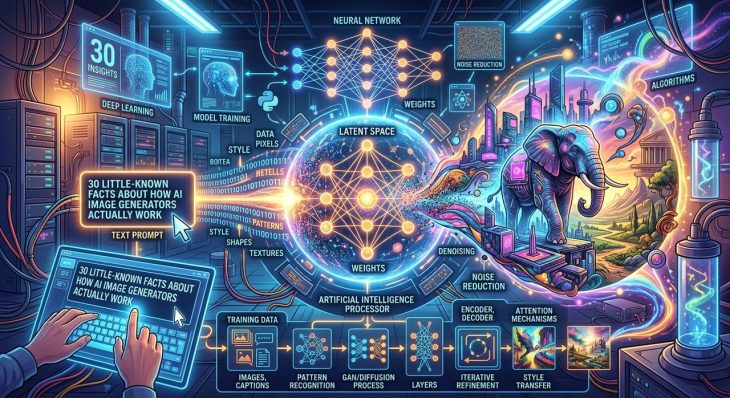
30 Little-Known Facts About How AI Image Generators Actually Work
AI image generators feel like magic. Type a few words, and a photorealistic portrait or surreal alien city appears in seconds. But the science underneath that simple text box is genuinely strange and far more interesting than "the computer just drew something." Here are 30 facts that pull back the curtain on one of the most surprising technologies in recent memory.
The Big Picture: Modern AI image generators are not drawing tools. They are statistical noise machines trained to reverse chaos into coherent pictures.
- The underlying math borrows from physics equations that describe how particles diffuse through liquids.
- They were trained on hundreds of millions of labeled images collected from across the public web.
- Most of the generation process happens in a compressed mathematical space, invisible until the final pixels appear.
A Brief and Surprising History
The story of AI-generated images does not start with the sleek tools we use today. It starts with blurry, nightmare-fuel faces.
The first widely recognized system for generating photorealistic images from scratch was a Generative Adversarial Network, or GAN, introduced by Ian Goodfellow in 2014. GANs work by pitting two neural networks against each other: one generates fake images, the other tries to detect them. The generator gets better by learning from every failure to fool the detector.
Early GAN outputs were famously strange. A 2017 image of a fake celebrity face trained on a dataset called CelebA could fool a human at a glance, but fell apart under scrutiny. Teeth looked melted. Ears were asymmetrical in uncanny ways. Background details dissolved into noise.
By 2018, NVIDIA's StyleGAN produced faces so convincing that the website "This Person Does Not Exist" launched as a viral demonstration. Every face on that site was completely synthetic, and millions of people had no idea.
GANs dominated generative image AI for roughly seven years. Then diffusion models arrived, and the field shifted almost overnight.
What Diffusion Models Actually Are
The concept of a diffusion model is borrowed from thermodynamics. In physics, diffusion describes how a drop of ink spreads through water until it disappears into uniform randomness. A diffusion model in AI runs that process in reverse.
During training, the model is shown millions of real images. For each image, it applies a series of small random noise additions, step by step, until the original picture is unrecognizable. The model then learns to predict, at each step, what the image looked like before the noise was added. After enough training, it can start from pure random static and walk backward through those same steps to reconstruct a coherent picture.
This is called latent diffusion, and it is the mechanism behind Stable Diffusion, DALL-E 3, Midjourney, and most of today's flagship image tools. The "latent" part refers to the fact that the model does not work directly with pixels. Instead, it compresses images into a much smaller mathematical representation called a latent space, runs the denoising process there, and only converts back to pixels at the very end. This compression is what makes the process fast enough to run on consumer hardware.
Anyone curious to see latent diffusion in action can use an AI image generator directly in a browser, no software installation required.
The Training Data Behind the Models
The scale of the data used to train these models is hard to grasp.
Stable Diffusion 1.x was trained on a subset of the LAION-5B dataset, a collection of roughly five billion image-text pairs assembled from publicly accessible web pages. That is more images than a person could look at in a thousand lifetimes.
Text descriptions paired with images, called captions or alt text, are critical. Models learn the relationship between words and visual concepts by seeing both together millions of times. A caption that says "a golden retriever on a red couch" teaches the model to associate those specific words with specific pixel patterns.
Many training datasets include images with watermarks. As a result, early versions of several models would spontaneously add faint watermark-like artifacts to generated images, even when no watermark was intended. This quirk became one of the earliest clues that models were memorizing patterns rather than understanding concepts.
Some training images included copyrighted artworks. This sparked ongoing legal debates in several countries about whether training on publicly available data constitutes infringement. As of mid-2025, courts in the United States, United Kingdom, and European Union were still wrestling with the question, with no single consistent ruling across jurisdictions.
Models trained on geographically skewed datasets also produce geographically skewed outputs. A model trained primarily on English-language web content tends to generate images reflecting North American and European aesthetics by default, even when the prompt contains no geographic reference.
How Your Text Prompt Becomes an Image
When you type a prompt, the text is not handed directly to the image model. It first passes through a separate language model called a text encoder.
The most common text encoder used in open-source diffusion systems is a component called CLIP, developed by OpenAI in 2021. CLIP was trained to match images and text descriptions, and it converts your prompt into a long list of numbers, called an embedding, that captures the meaning of what you wrote. That embedding is what actually guides the denoising process.
The number of denoising steps matters enormously. A typical generation uses somewhere between 20 and 50 steps. Fewer steps means faster generation but rougher, less coherent results. More steps means finer detail but longer wait times. Some optimized systems like LCM (Latent Consistency Model) can produce reasonable images in as few as 4 steps.
There is a parameter called guidance scale, sometimes called CFG scale, that controls how closely the model sticks to your prompt versus how freely it generates. A low guidance scale produces more creative but less literal results. A very high guidance scale can cause over-saturation and visual artifacts as the model overcorrects toward your text.
What AI Models Struggle With Most
Despite their remarkable outputs, diffusion models have well-documented weak spots.
Hands remain the most famous failure point. Human fingers involve complex spatial relationships and high variability in training data. Models trained on general web images see far fewer close-up hand photographs than face photographs, so hand generation tends to go wrong in memorable ways: too many fingers, fused knuckles, or palms that suggest an alien anatomy.
Text inside generated images is almost always garbled. Because character-level letter forms are not meaningfully represented in the image-text training pairs used by most models, the model cannot reliably reproduce legible words within a picture. Newer architectures trained with OCR-aware objectives have improved this, but it remains a weaker area than faces or landscapes.
Models also struggle with counting. Asking for "three red apples" might produce two or four. The spatial reasoning required to place an exact number of discrete objects is not naturally encoded in the pixel-statistics the model learns.
The Science of Segmentation and Background Removal
Here is a fact that surprises most people: the AI segmentation technology that powers consumer background remover tools was originally developed for medical imaging.
Isolating a foreground subject from its background requires a model to draw precise pixel-by-pixel boundaries around complex shapes. In the early 2010s, this kind of dense pixel classification, called semantic segmentation, was primarily studied to identify tumors in MRI scans or segment organs in surgical planning images. The architectures built for that purpose, particularly U-Net, introduced in 2015 by researchers at the University of Freiburg, turned out to generalize remarkably well to natural photographs. U-Net later became a core building block of modern diffusion models themselves.
Facts About Speed, Size, and Scale
- The original Stable Diffusion 1.4 model weighs roughly 4 gigabytes on disk when stored in half-precision format, containing approximately 890 million individual parameters.
- Running a 50-step generation on a modern GPU takes less than two seconds; on the CPU of an average laptop, it can take several minutes.
- Some enterprise-scale text-to-image systems use models with more than 10 billion parameters, compared to roughly 1.7 billion for GPT-2, which seemed enormous when it launched in 2019.
- The computational cost of training Stable Diffusion 2 was estimated at around 200,000 GPU-hours. At standard cloud compute rates in 2022, that represented hundreds of thousands of dollars in hardware time.
- Image generation models often produce slightly different results from the same prompt on different runs because the denoising process starts from randomly sampled noise. Fixing the random seed makes the process deterministic, producing identical output every time.
- Inpainting, where you mask part of an existing image and ask the model to fill it in, uses the same diffusion process but conditions the denoising on the unmasked pixels as additional context.
The Strangest Corner Cases
Some of the most interesting facts about AI image generators come from edge cases and unexpected behaviors discovered by researchers and curious users.
Certain text prompts consistently produce similar visual outputs across models trained independently, suggesting that the underlying relationship between concepts and pixel patterns is not arbitrary. Words like "astronaut," "sunset," and "renaissance painting" tend to activate visually consistent representations across different architectures.
Models can be guided by negative prompts, a list of things you do not want in the image. Adding "blurry, watermark, extra fingers" to a negative prompt often improves quality more noticeably than refining the positive prompt alone.
Researchers have discovered that diffusion models sometimes memorize specific training images, particularly for concepts that appeared fewer times in the training data. When a concept has limited representation, the model may effectively reproduce one of the few examples it saw rather than generating something new. This raised significant concerns about whether generated images could inadvertently reproduce copyrighted photographs nearly verbatim.
The phenomenon of mode collapse, more commonly associated with GANs, can affect diffusion models too. When a concept is overrepresented in training data with low variety, the model tends to produce that concept in very similar compositions every time, regardless of how the prompt varies.
Some models exhibit concept bleed: when two concepts share visual features in training data, they can activate each other unexpectedly. A well-known example is the unintended association between the word "nurse" and specific demographic characteristics in older model versions, reflecting the demographics most represented in training images tagged with that label.
AI image generators can also be guided by image prompts rather than text, a technique called image-to-image generation. The user provides an existing image as a starting point, and the model treats it as partial information to build from, effectively repainting it in a new style or continuing an unfinished composition.
The 30 Facts, Brought Together
Taken as a whole, these facts paint a picture of a technology that is simultaneously simpler and stranger than its polished consumer interfaces suggest. Diffusion models do not "think" about images. They do not have a concept of beauty, or depth, or what a hand is supposed to look like. They are extraordinarily sophisticated pattern-matching engines built on generative adversarial network research, thermodynamic metaphors, and billions of images that ordinary people posted on the internet over two decades.
What makes the technology remarkable is precisely that such a mechanical process produces outputs that feel meaningful. The gap between the math and the result is where the magic seems to live.
What These 30 Facts Tell Us About Where AI Images Are Heading
The pace of improvement in AI image generation over the past five years has been faster than almost anyone predicted. In 2020, state-of-the-art models struggled to produce a recognizable human face at 256 pixels square. By 2024, multiple consumer tools were generating 4K photorealistic images in seconds. The trajectory suggests that many of the current limitations, hands, text, counting, and spatial reasoning, will narrow significantly within the next few development cycles. Understanding how these systems actually work, not just what they can produce, is the best foundation for thinking clearly about both the possibilities and the real concerns that come with them.
Was this page helpful?
Our commitment to delivering trustworthy and engaging content is at the heart of what we do. Each fact on our site is contributed by real users like you, bringing a wealth of diverse insights and information. To ensure the highest standards of accuracy and reliability, our dedicated editors meticulously review each submission. This process guarantees that the facts we share are not only fascinating but also credible. Trust in our commitment to quality and authenticity as you explore and learn with us.