
Written by: The Editorial Team
Published: 30 Jul 2026
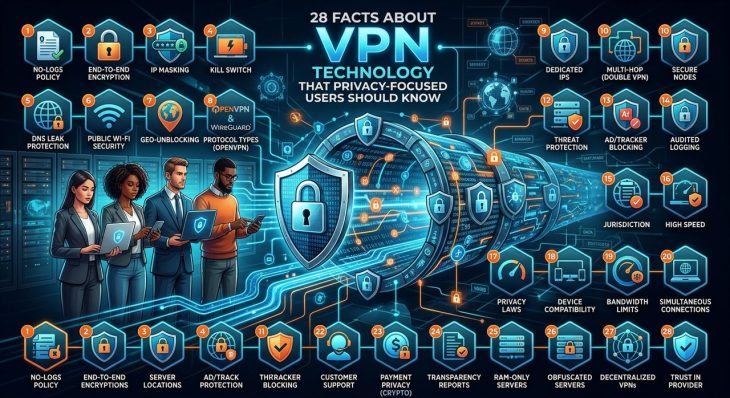
28 Facts About VPN Technology That Privacy-Focused Users Should Know
VPNs have gone from niche corporate tools to mainstream privacy products in less than three decades. Millions of people use them daily without knowing much about the technology underneath. Some beliefs floating around the internet about VPNs are flat-out wrong. Others are partially true but missing critical context. These 28 facts cut through the noise and give you a clearer picture of what a VPN actually does, where the technology came from, and what its real limits are.
Most people misunderstand what a VPN actually protects. Here is what the facts show:
- A VPN hides your traffic from your internet provider and masks your IP address, but it does not make you anonymous online.
- AES-256 encryption, used by most premium VPNs, is the same standard trusted by government agencies for classified communications.
- The original tunneling protocols from the 1990s are now considered insecure, and modern alternatives like WireGuard have replaced them in most serious deployments.
The Origins: Tunneling Protocols in the 1990s
Fact 1. The first widely used VPN protocol, PPTP (Point-to-Point Tunneling Protocol), was developed by a vendor consortium led by Microsoft and submitted to the IETF in 1996. It was built to let remote workers connect securely to corporate networks over dial-up internet connections, not to protect personal privacy.
Fact 2. PPTP works by wrapping regular network packets inside a GRE (Generic Routing Encapsulation) tunnel. This "packet within a packet" approach is the core idea behind all tunneling protocols, even the modern ones used today.
Fact 3. L2TP (Layer 2 Tunneling Protocol) arrived in 1999 as a successor to PPTP. It combined elements from Cisco's L2F protocol and Microsoft's PPTP. L2TP on its own provides no encryption, which is why it is almost always paired with IPsec.
Fact 4. The "tunnel" in VPN tunneling is a metaphor. Your data does not travel through a separate physical pipe. It is encapsulated and encrypted so that anyone intercepting it sees only scrambled, unreadable content rather than the original payload.
Fact 5. SSL VPNs emerged in the early 2000s and operate at the application layer rather than the network layer. This made them much easier to deploy through firewalls, since they use port 443, the same port as standard HTTPS web traffic.
Encryption: What AES-256 Actually Means
Fact 6. AES stands for Advanced Encryption Standard. It was selected by the U.S. National Institute of Standards and Technology in 2001 after a five-year public competition involving cryptographers from around the world. The winning algorithm was Rijndael, developed by Belgian cryptographers Joan Daemen and Vincent Rijmen. You can read more about this process on the AES selection history Wikipedia page.
Fact 7. The "256" in AES-256 refers to the key length: 256 bits. A 256-bit key has 2 to the power of 256 possible combinations. That number is so astronomically large that even the fastest computers on earth could not brute-force it within the lifetime of the universe.
Fact 8. The U.S. National Security Agency approved AES-256 for encrypting information classified at the TOP SECRET level. This is the same cipher that most consumer VPN services use to protect your browsing traffic.
Fact 9. AES-128 is also considered secure. The difference between 128-bit and 256-bit AES is not meaningful for practical security today. AES-256 is chosen partly for future-proofing against theoretical quantum computing attacks and partly for marketing clarity.
Fact 10. Encryption strength is only part of the story. A VPN with perfect encryption can still leak your data if the protocol implementation has vulnerabilities, if the handshake uses a weak cipher suite, or if the software has bugs. Protocol design matters as much as key length.
Anonymity Versus Privacy: A Critical Distinction
Fact 11. A VPN provides privacy, not anonymity. Those two words are not interchangeable. Privacy means others cannot see what you are doing. Anonymity means others cannot tell who you are. A VPN does the first. It does not reliably do the second.
Fact 12. Your VPN provider can see your real IP address and, if they keep logs, what websites you visit. When someone says a VPN "hides your activity," they mean it hides your activity from your ISP and from the websites you visit. It moves trust to the VPN provider instead of eliminating it.
Fact 13. No-log policies are only as trustworthy as the audits that verify them. Several VPN companies have claimed no-log practices and then handed over user data to law enforcement when legally compelled. Independent third-party audits of server configurations and code are a stronger signal than marketing language.
Fact 14. WebRTC leaks are one of the most overlooked VPN vulnerabilities. Browsers use WebRTC for real-time communication features, and this can expose your real IP address even when a VPN is active. Many VPN clients do not block WebRTC by default. Checking for this leak with a dedicated test tool is something privacy-conscious users should do regularly.
Fact 15. DNS leaks happen when your device sends DNS queries outside the VPN tunnel. Even with your traffic encrypted, your ISP can see which domain names you are looking up if your DNS requests bypass the VPN server. A properly configured VPN routes DNS through its own resolver.
Five Things Most People Get Wrong About VPNs
Here are five specific misconceptions that come up repeatedly in privacy discussions, stated plainly so they are easy to reference:
- A VPN does not stop websites from tracking you via cookies, browser fingerprinting, or login sessions. If you log into Google on a VPN, Google still knows who you are.
- Free VPNs are frequently funded by selling user data to advertisers, which directly undermines the privacy goal most people have when installing a VPN.
- A VPN does not protect you from malware. It encrypts your connection but it does not scan files you download or block malicious scripts on websites you visit.
- Using a VPN does not necessarily make you a target for scrutiny. In most countries with VPN access, law enforcement focuses on behavior patterns and content, not the use of privacy tools.
- A VPN exit node's country determines which legal jurisdiction your traffic appears to originate from, but this does not grant you that country's legal protections as a person living elsewhere.
Modern Protocol Developments
Fact 16. OpenVPN, released in 2001, became the gold standard for open-source VPN protocols for nearly two decades. It is highly configurable, audited by multiple independent security researchers, and runs on almost every platform. Its main drawback is speed: the codebase is large and connections can be slower than newer alternatives.
Fact 17. WireGuard was publicly released in 2015 and merged into the Linux kernel in 2020. It has a codebase of roughly 4,000 lines of code compared to OpenVPN's hundreds of thousands. Fewer lines of code means a smaller attack surface and faster security audits.
Fact 18. Understanding how VPNs work at the protocol-stack level, from the handshake to the encryption layer, helps clarify why WireGuard's design choices result in measurably faster connection times and lower latency than legacy protocols.
Fact 19. IKEv2/IPsec is particularly well-suited to mobile devices because it supports MOBIKE, a feature that allows a VPN session to persist when a device switches between Wi-Fi and cellular networks. This prevents the connection from dropping during a transition.
Fact 20. The Tor network and VPNs are often confused. Tor routes traffic through at least three volunteer-run relay nodes and is designed specifically for anonymity. VPNs use a single server hop and are optimized for speed and privacy. Using both together (Tor over VPN) is possible but significantly slows your connection.
Jurisdictional and Legal Facts
Fact 21. The Five Eyes intelligence alliance, consisting of the United States, United Kingdom, Canada, Australia, and New Zealand, has formal agreements to share signals intelligence data. VPN providers based in Five Eyes countries can be subject to legal orders requiring data disclosure and, in some cases, gag orders preventing them from telling users this has happened.
Fact 22. VPNs are illegal or heavily restricted in several countries, including China, Russia, Iran, North Korea, and Belarus. In China, only government-approved VPNs are technically permitted, though enforcement against individual users varies.
Fact 23. In most of the European Union, United States, and United Kingdom, using a VPN is entirely legal. A VPN is a tool. What matters legally is what you do with it, not the fact that you use one.
Fact 24. Some VPN providers incorporate RAM-only servers, which store no data on physical hard drives. When the server shuts down or is seized by authorities, all data is gone because nothing is written to disk. This is a meaningful architectural privacy choice, not just a marketing feature.
Performance, Speed, and Practical Reality
Fact 25. All VPNs slow your connection to some degree because encryption and decryption require processing time, and routing through an additional server adds network latency. Modern protocols like WireGuard have reduced this overhead dramatically. With a fast VPN server in a nearby location, speed loss can be under five percent.
Fact 26. Server location relative to your physical location is the single biggest factor affecting VPN speed. Connecting to a server on another continent adds significant round-trip latency regardless of protocol quality.
Fact 27. Split tunneling lets you route some traffic through the VPN while other traffic uses your regular internet connection. You might send your torrent client through the VPN while your video streaming goes direct, preserving bandwidth for time-sensitive content.
Fact 28. VPN kill switches automatically cut your internet connection if the VPN drops unexpectedly. Without one, a brief VPN disconnect would expose your real IP address and unencrypted traffic to your ISP for however long it takes to reconnect.
What These 28 Facts Add Up To
VPN technology is more layered and nuanced than most marketing makes it out to be. The tunneling protocols built in the 1990s solved a real problem for corporate IT teams, and the cryptographic standards they eventually adopted, especially AES-256, are genuinely strong. But no encryption standard fixes a flawed trust model, no protocol eliminates the distinction between privacy and anonymity, and no tool removes the need to understand what you are actually protecting against.
The most privacy-conscious users treat a VPN as one layer in a broader approach, not as a complete solution. They know which protocol their software uses, whether their provider has been independently audited, and what specific threats they are trying to reduce. That knowledge starts with understanding the basics and goes deeper from there.
The facts above are a starting point. The more you know about the technology underneath, the better equipped you are to make decisions that actually match your privacy goals rather than just your peace of mind.
---
For deeper technical reading on encryption standards, the NIST AES documentation provides the original competition timeline and specification background.
Was this page helpful?
Our commitment to delivering trustworthy and engaging content is at the heart of what we do. Each fact on our site is contributed by real users like you, bringing a wealth of diverse insights and information. To ensure the highest standards of accuracy and reliability, our dedicated editors meticulously review each submission. This process guarantees that the facts we share are not only fascinating but also credible. Trust in our commitment to quality and authenticity as you explore and learn with us.